Ring system
Videos
A ring system is a disc or torus orbiting an astronomical object that is composed of numerous solid bodies such as dust particles, meteoroids, minor planets, moonlets, or stellar objects.

The ring orbiting Saturn consists mostly of chunks of ice and dust. The small dark spot on Saturn is the shadow from Saturn's moon Enceladus.

Silhouette of Chariklo and its rings on 23 July 2017, revealed by occultation observations from various locations on Earth

Artist's depiction of Haumea's ring system

A Galileo image of Jupiter's main ring.
Rings of Uranus
Videos
The rings of Uranus consist of 13 planetary rings. They are intermediate in complexity between the more extensive set around Saturn and the simpler systems around Jupiter and Neptune. The rings of Ura
Ring system
…be found around other types of astronomical objects, including moons and brown dwarfs. In the Solar System, all four giant planets (Jupiter, Saturn, Uranus, and Neptune) have ring systems, but Saturn's ring system is the biggest and the most visible one out of the four. Ring systems around minor planets…

False color Hubble Space Telescope image of Uranus. The rings are visible, particularly at the bottom and top.

A close-up view of the ε ring of Uranus
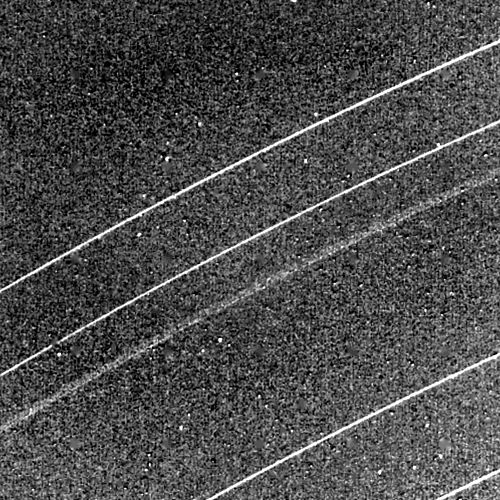
A close-up view of the (from top to bottom) δ, γ, η, β and α rings of Uranus. The resolved η ring demonstrates the optically thin broad component.

The discovery image of the 1986U2R ring