Robert Risson
Videos
Major General Sir Robert Joseph Henry Risson, was an Australian engineer, soldier, and tramway administrator. After university he worked for the Brisbane Tramways Trust, later under the auspice of Brisbane City Council, as an engineer and administrator. During World War II Risson served in the Middle East and New Guinea. Following the war he returned to the Brisbane tramways, and became chairman of the Melbourne and Metropolitan Tramways Board from 1949 to 1970. In this position he defended trams, and is considered a major factor in the survival of Melbourne's tram system. Risson had ties with a myriad of professional and community organisations, including the Freemasons, where he served as Grand Master of the United Grand Lodge of Victoria in the mid-1970s. Risson was decorated for his service, holding the rank of major general and being knighted.


University of Queensland Rugby Club in 1930. Risson is in the front row, second from the left.

Prince Henry, Duke of Gloucester shakes hands with Lieutenant Colonel Risson, before inspecting the 9th Division, engineers, Tripoli, Syria, 1942.

Lieutenant General Sir Leslie Morshead pinning the OBE ribbon on Lieutenant Colonel Risson, El Alamein, 1942.
3rd Division (Australia)
Videos
The 3rd Division was an infantry division of the Australian Army. Existing during various periods between 1916 and 1991, it is considered the "longest serving Australian Army division". It was first formed during World War I, as an infantry division of the Australian Imperial Force and saw service on the Western Front in France and Belgium. During this time it fought major battles at Messines, Broodseinde Ridge, Passchendaele, Amiens, and the St Quentin Canal.
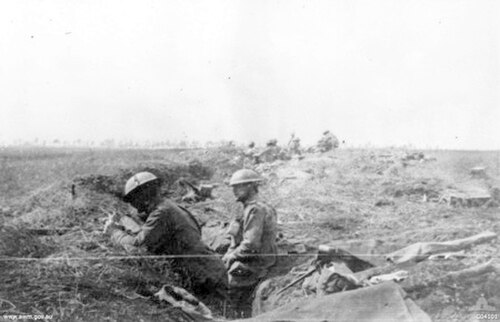
3rd Division troops around Lena Wood, 8 August 1918

The 108th Howitzer Battery in action around Bray, August 1918

Men from the 61st Battalion patrol along the Mosigetta River on Bougainville in March 1945

Troops from the 3rd Division cross the Hongorai River alongside Matilda tanks from the 2/4th Armoured Regiment in May 1945