Rock of Gibraltar
Videos
The Rock of Gibraltar is a monolithic limestone mountain 426 m high dominating the western entrance to the Mediterranean Sea at the Strait of Gibraltar. It is situated near the end of a narrow 9-kilom

Western face of the Rock of Gibraltar, in April 2006

Levant cloud forming against the eastern cliffs of the Rock of Gibraltar

The sheer east side of the Rock of Gibraltar

Eastern face, Rock of Gibraltar, in 1880, viewed from N-E
Strait of Gibraltar
Videos
The Strait of Gibraltar, also known as the Straits of Gibraltar, is a narrow strait that connects the Atlantic Ocean to the Mediterranean Sea and separates Europe from Africa. The two continents are s
Rock of Gibraltar
…The Rock of Gibraltar is a monolithic limestone mountain 426 m (1,398 ft) high dominating the western entrance to the Mediterranean Sea at the Strait of Gibraltar. It is situated near the end of a narrow 9-kilometre-long (5.6 mi) promontory stretching due south into the Mediterranean Sea and is located within the…
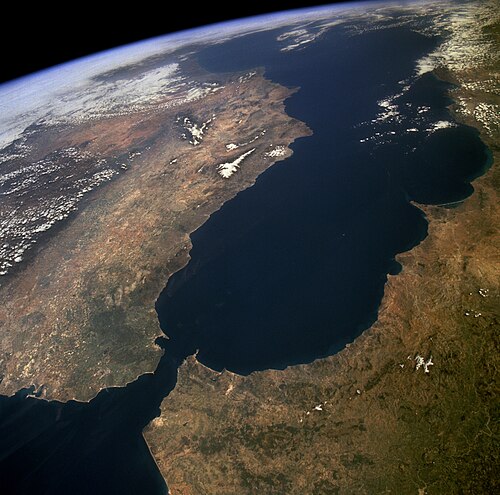
The Strait of Gibraltar as seen from space. The Iberian Peninsula is on the left and the Maghreb is on the right.

Europe (left) and Africa (right)

A view across the Strait of Gibraltar taken from the hills above Tarifa, Spain
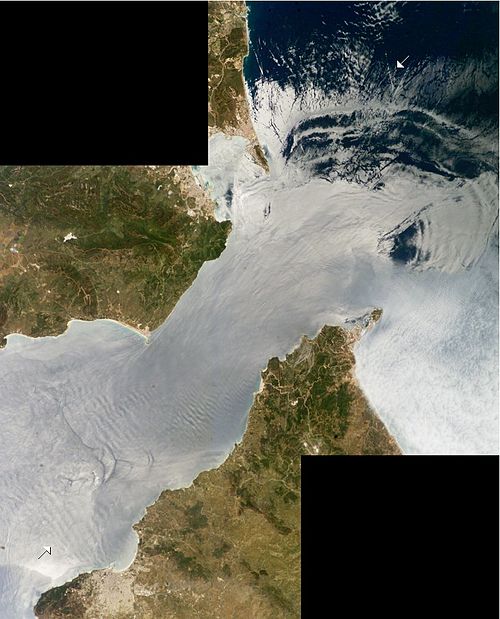
The Strait of Gibraltar with the Mediterranean Sea in upper right. Internal waves (marked with arrows) are caused by water flowing through the Strait (bottom left, top right).