Roman–Parthian War of 58–63
Videos
The Roman–Parthian War of 58–63 or the War of the Armenian Succession was fought between the Roman Empire and the Parthian Empire over control of Armenia, an important buffer state between the two rea
Relief depicting a Parthian horse-archer. Highly skilled and mobile, they formed the backbone of the Parthian army. In combination with the heavy cataphract cavalry they formed a very effective force that had already annihilated a Roman army at Carrhae.


Silver coin of Vologases I, King of Parthia.

Celebratory as struck in 66, showing the gates of the Temple of Janus closed as a symbol of universal peace. It would not last long: in the same year, the Jewish Revolt broke out, and many of the units involved in the Armenian War would be deployed against the Jewish rebels.
Parthian Empire
Videos
The Parthian Empire, also known as the Arsacid Empire, was a major Iranian political and cultural power centered in ancient Iran from 247 BC to 224 AD. Its latter name comes from its founder, Arsaces

The silver drachma of Arsaces I (r. c. 247 – 211 BC) with the Greek language inscription ΑΡΣΑΚΟΥ "of Arsaces"
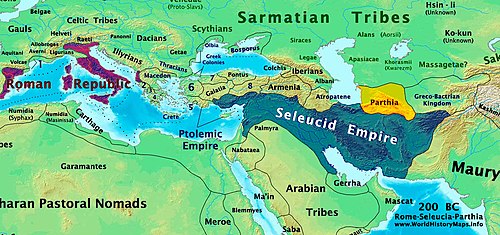
Parthia, shaded yellow, alongside the Seleucid Empire (blue) and the Roman Republic (purple) around 200 BC

Drachma of Mithridates I, showing him wearing a beard and a royal diadem on his head. Reverse side: Heracles/Verethragna, holding a club in his left hand and a cup in his right hand; Greek inscription reading ΒΑΣΙΛΕΩΣ ΜΕΓΑΛΟΥ ΑΡΣΑΚΟΥ ΦΙΛΕΛΛΗΝΟΣ "of the Great King Arsaces the Philhellene"

Statue of a Parthian woman, marble from Nisa; National Museum of History, Ashgabat, Turkmenistan