Roman–Persian wars
Videos
The Roman–Persian wars, also called the Roman–Iranian wars, took place between the Greco-Roman world and the Iranian world, beginning with the Roman Republic and the Parthian Empire in 54 BC and endin
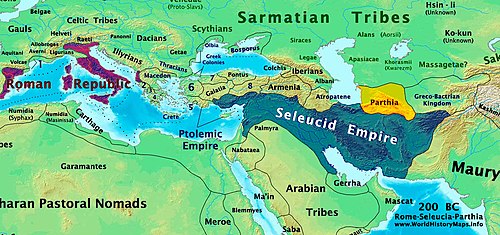
Rome, Parthia, and Seleucid Empire in 200 BC. Soon both the Romans and the Parthians would invade the Seleucid-held territories and become the strongest states in western Asia.

The Nisa helmeted warrior, a Hellenistic figure or deity, from the Parthian royal residence and necropolis of Nisa, Turkmenistan, 2nd century BC

Parthia, its subkingdoms, and neighbors in 1 AD

Reliefs depicting war with Parthia on the Arch of Septimius Severus, built to commemorate the Roman victories
Sasanian Empire
Videos
The Sasanian Empire, officially Eranshahr, was an Iranian empire that was founded and ruled by the House of Sasan from 224 to 651 AD. Lasting for over four centuries, the length of the Sasanian dynast

Initial coinage of founder Ardashir I, as King of Persis Artaxerxes (Ardaxsir) V. c. 205/6–223/4 AD. Obverse: Bearded facing head, wearing diadem and Parthian-style tiara, legend "The divine Ardaxir, king" in Pahlavi. Reverse: Bearded head of Papak, wearing diadem and Parthian-style tiara, legend "son of the divinity Papak, king" in Pahlavi.

1840 illustration of a Sasanian relief at Firuzabad, showing Ardashir I's victory over Artabanus IV and his forces.

Rock relief of Ardashir I receiving the ring of kingship by the Zoroastrian supreme god Ahura Mazda

Rock-face relief at Naqsh-e Rostam of Persian emperor Shapur I (on horseback) capturing Roman emperor Valerian (standing) and Philip the Arab (kneeling), suing for peace, following the victory at Edessa.