Roman aqueduct
Videos
The Romans constructed aqueducts throughout their Republic and later Empire, to bring water from outside sources into cities and towns. Aqueduct water supplied public baths, latrines, fountains, and p
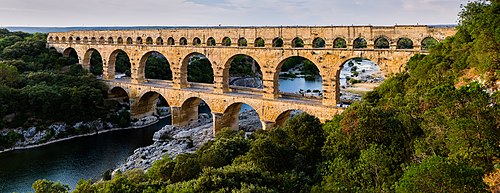
The multiple arches of the Pont du Gard in Roman Gaul (modern-day southern France). The upper tier encloses an aqueduct that carried water to Nimes in Roman times; its lower tier was expanded in the 1740s to carry a wide road across the river.

Parco degli Acquedotti, a park in Rome named after the aqueducts that run through it

Ruins of the Aqua Anio Vetus, a Roman aqueduct built in 272 BC

Galería de los Espejos (Gallery of Mirrors), a tunnelled part of a 25 km Roman aqueduct built during the 1st century AD near Albarracín (Spain)
Aqua Virgo
Videos
The Aqua Virgo was one of the eleven Roman aqueducts that supplied the city of ancient Rome. It was completed in 19 BC by Marcus Agrippa, during the reign of the emperor Augustus and was built mainly

Route of the Aqua Virgo

The only remains above ground, in via del Nazzareno

60 metres (200 ft) stretch of the aqueduct arches, recently found inside the Rinascente shopping complex

Modern day windlass used for an Anchor