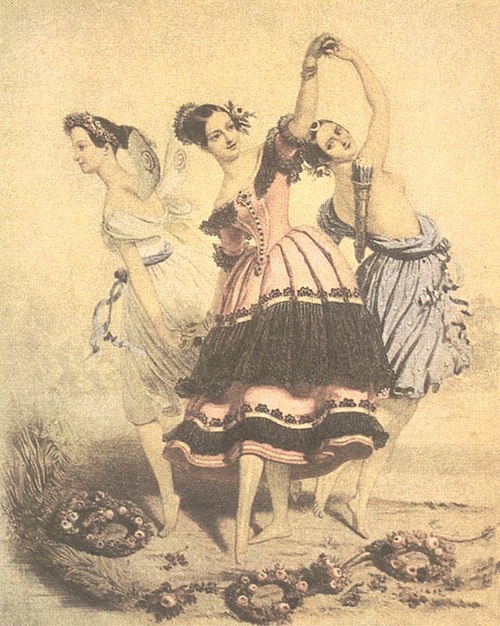
The Romantic ballet is defined primarily by an era in ballet in which the ideas of Romanticism in art and literature influenced the creation of ballets. The era occurred during the early to mid 19th century primarily at the Théâtre de l'Académie Royale de Musique of the Paris Opera Ballet and Her Majesty's Theatre in London. It is typically considered to have begun with the 1827 début in Paris of the ballerina Marie Taglioni in the ballet La Sylphide, and to have reached its zenith with the premiere of the divertissement Pas de Quatre staged by the Ballet Master Jules Perrot in London in 1845. The Romantic ballet had no immediate end, but rather a slow decline. Arthur Saint-Léon's 1870 ballet Coppélia is considered to be the last work of the Romantic Ballet. Romantic ballet is believed to have been experienced in three main phases: The zenith phase from 1830-1840, the decline phase from 1850-1880, and the revival phase in the 1890s prior to Diaghilev. Each phase is synonymous with the production of a few specifically stylized ballets.
Lithograph by A. E. Chalon of Carlotta Grisi (left), Marie Taglioni (center), Lucille Grahn (right back), and Fanny Cerrito (right front) in the Perrot/Pugni Pas de Quatre, London, 1845. The premiere of the Pas de Quatre is considered to be the Romantic ballet at its zenith.
The Salle Le Peletier or Lepeletier was the home of the Paris Opera from 1821 until the building was destroyed by fire in 1873. The theatre was designed and constructed by the architect François Debret on the site of the garden of the Hôtel de Choiseul on the rue Lepeletier. Due to the many changes in government and management during the theatre's existence, it had a number of different official names, the most important of which were: Théâtre de l'Académie Royale de Musique (1821–1848), Opéra-Théâtre de la Nation (1848–1850), Théâtre de l'Académie Nationale de Musique (1850–1852), Théâtre de l'Académie Impériale de Musique (1852–1854), Théâtre Impérial de l'Opéra (1854–1870), and Théâtre National de l'Opéra (1870–1873).
The Théâtre de l'Académie Royale de Musique, the official title of the Paris Opera c. 1821
Performance of Charles-Simon Catel's opera Les bayadères for the inauguration of the Paris Opera's Salle Le Peletier on 16 August 1821
The ballet Giselle during a state visit of Tsar Alexander II (4 June 1867)
The Principal Ballerinas of the Paris Opera (clockwise from top left): Lise Noblet, Marie Taglioni, Mlle Julia [de Varennes], Alexis Dupont (née Félicité Noblet, she used the name of her husband Alexis Dupont), Amélie Legallois, and Pauline Montessu, premiers sujets in 1831.