Romulus and Remus
Videos
In Roman mythology, Romulus and Remus are twin brothers whose story tells of the events that led to the founding of the city of Rome and the Roman Kingdom by Romulus, following his fratricide of Remus

La Lupa Capitolina ("the Capitoline Wolf"). Traditional scholarship says the wolf-figure is Etruscan, 5th century BC. The figures of Romulus and Remus were added in the 15th century AD by Antonio del Pollaiuolo. Some modern research suggests that the she-wolf may be a Romanesque sculpture dating from the 13th century AD.

Altar to Mars (divine father of Romulus and Remus) and Venus (their divine ancestress) depicting elements of their legend. The god Tiberinus ("Father Tiber") and the infant twins being suckled by a she-wolf in the Lupercal are below. A vulture from the contest of augury and Palatine Hill are to the left. (From Ostia, now at the Palazzo Massimo alle Terme)

The Shepherd Faustulus Bringing Romulus and Remus to His Wife, Nicolas Mignard (1654)

Romulus and Remus on the House of the She-wolf at the Grand-Place of Brussels
Romulus
Videos
Romulus was the legendary founder and first king of Rome. Various traditions attribute the establishment of many of Rome's oldest legal, political, religious, and social institutions to Romulus and hi
Romulus and Remus
…Romulus and Remus (Latin: , ) are twin brothers whose story tells of the events that led to the founding of the city of Rome and the Roman Kingdom by Romulus, following his fratricide of Remus. The image of a she-wolf suckling the twins in their infancy has been a symbol of the city of Rome and the ancient…

Romulus and his twin brother Remus from a 15th-century frieze, Certosa di Pavia
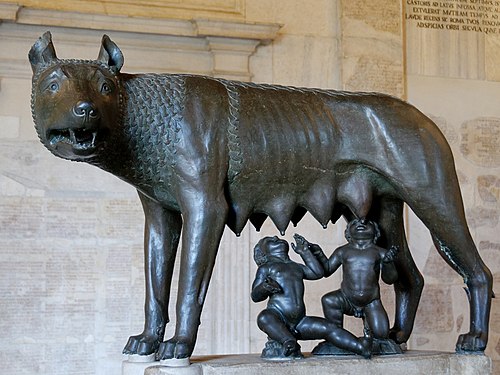
A statue of a She-wolf depicts the twins suckling.

Roman Denarius with Romulus as Quirinus

Romulus dedicating the temple to Jupiter Feretrius