Round Foundry
Videos
The Round Foundry is a former engineering works off Water Lane in Holbeck, Leeds, West Yorkshire, England. Founded in the late 18th century, the building was developed into the Round Foundry Media Cen

Representation of the Round Foundry and rotunda from Water Lane in the 19th century.

No. 97 Water Lane, originally a workshop forming part of the Round Foundry, built 1857–1877. Fenton, Murray and Jackson closed in 1843, this building built by Smith, Beacock and Tannett, machine tool manufacturers, who took over the site and renamed it Victorian Foundry. No. 99 in the distance.

Water Lane and former Round Foundry buildings: No. 99 (left) considered the remains of the Green Sand foundry, built by Matthew Murray. No. 101 (centre) also believed to date from 1795 to 1802.

Foundry Square, No. 99 (right) with double doors. Dry Sand foundry (left).
Matthew Murray
Videos
Matthew Murray was an English steam engine and machine tool manufacturer, who designed and built the first commercially viable steam locomotive, the twin-cylinder Salamanca in 1812. He was an innovati
Round Foundry
…was developed into the Round Foundry Media Centre in 2005. The Round Foundry was built in 1795–1797 by a partnership of James Fenton (1754–1834), Matthew Murray, David Wood and the financier William Lister, trading as Fenton, Murray and Wood, (later Fenton, Murray and Jackson). It was at the Round Foundry that…

Matthew Murray

Technical drawing of a 4hp steam engine by Fenton, Murray & Wood, 1802. "Applied to a mill for grinding bark", by Joseph Wilson Lowry, after John Farey

The Collier, aquatint by Robert Havell after George Walker, published in 1814, from Costumes of Yorkshire, showing Blenkinsop's rack locomotive Salamanca on the Middleton Railway. The image features the earliest known representation of a steam train.
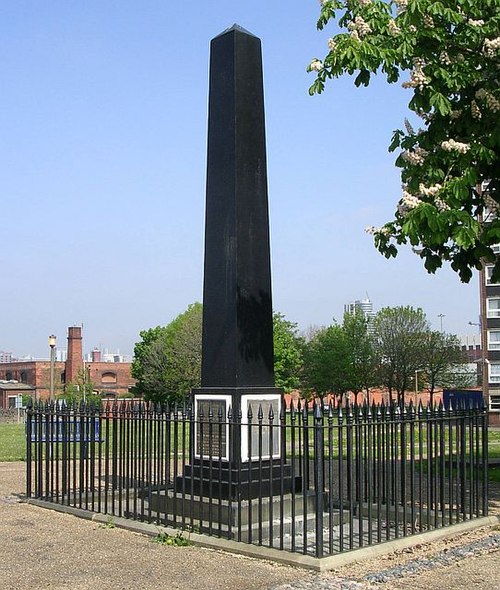
A memorial to Matthew Murray in Holbeck, Leeds