Roy Geiger
Videos
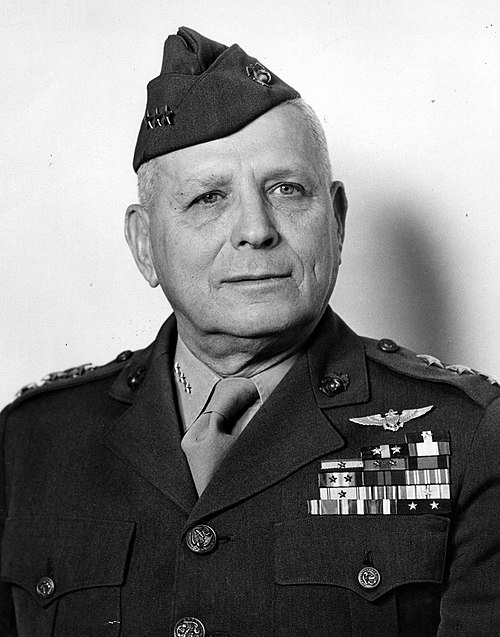
Roy Stanley Geiger was a United States Marine Corps four-star general who served in World War I and World War II. In World War II, he became the first Marine Corps general to lead a field army.
Lieutenant General Roy S. Geiger, U.S. Marine Corps

Geiger (third from left) and III MAC staff during the planning of Okinawa operation. From left to right: David R. Nimmer, Walter A. Wachtler, Geiger, Merwin H. Silverthorn, Sidney S. Wade, Francis B. Loomis Jr. and Gale T. Cummings.

Major General Roy S. Geiger (left), Marine III Amphibious Corps Commander, en route to Guam on board the command ship USS Appalachian. In the center is his Chief of Staff, Colonel Merwin H. Silverthorn and on the right is Brigadier General Pedro del Valle, Corps Artillery commander.

"General Roy S. Geiger Memorial Parkway" sign on County Road 220 in Clay County, Florida, just south of Jacksonville
Battle of Guam (1944)
Videos
The Battle of Guam was the American recapture of the Japanese-held island of Guam, an American territory in the Mariana Islands captured by the Japanese in the First Battle of Guam in 1941 during the
Roy Geiger
…was awarded the Distinguished Service Medal. Redesignated III Amphibious Corps in April 1944, he led this organization in the invasion and subsequent recapture of Guam during July and August 1944, and in the assault and capture of the southern Palau Islands in September and October of the same year. For those operations…
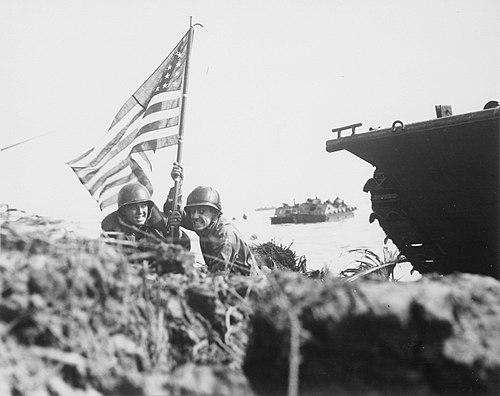
U.S. Army officers planting the American flag

Senior Navy and Marine Corps commanders. Left to right: Admiral Raymond A. Spruance, Lieutenant General Holland M. Smith, Rear Admiral Richard L. Conolly, Major General Henry L. Larsen and Major General Roy S. Geiger

Japanese infantry and tank dispositions on Guam, 21 July 1944

One gun of a 4-gun Japanese dual purpose 120 mm battery on hill east of the Orote Peninsula airfield. Revetments 21 feet (6.4 m) in diameter and 6 feet (1.8 m) deep. A two-inch (51 mm) pipe served as a speaking tube communicating from the command post to the guns.