Royal Alcázar of Madrid
Videos
The Royal Alcázar of Madrid was a fortress located at the site of today's Royal Palace of Madrid, Madrid, Spain. The structure was originally built in the second half of the ninth century by the Musli

17th-century painting of the Real Alcázar de Madrid. The southern facade (right) appears in its final 1636 phase by the architect Juan Gómez de Mora. The west facade (left) is from a much older structure, possibly the earliest Muslim castle which formed the basis for the different extensions later undertaken.

Drawing of the old Alcázar by Jan Cornelisz Vermeyen. The image is dated at around 1534, before the extension commissioned by Charles V in 1537 - the first important work to the building. It is likely that this was the appearance of the Umayyad castle, whose structure was the basis of the royal palace developed by the Emperor.

Part of the 1562 drawing by Anton van den Wyngaerde, in which the building can be seen as it was a year after Philip II chose Madrid as the site of his court.

Anonymous drawing of the building c. 1596–1597, when the work commissioned by Philip II was near completion. On the right, the Golden Tower, built by Juan Bautista of Toledo, can be seen in the southwestern corner of the Alcázar.
Las Meninas
Videos
Las Meninas is a 1656 oil painting in the Museo del Prado in Madrid, by Diego Velázquez, the leading artist in the court of King Philip IV of Spain and Portugal, and of the Spanish Golden Age. It has
Royal Alcázar of Madrid
…V (the first Bourbon king), on Christmas Eve 1734. Many artistic treasures were lost, including over 500 paintings. Other works, such as the painting Las Meninas by Velázquez, were saved. There is much documentation (numerous texts, engravings, plans, paintings and models) on the building layout and exterior…

Las Meninas, by Diego Velázquez, from Prado in Google Earth

The Infanta Margaret Theresa (1651–1673), in mourning dress for her father in 1666, by del Mazo. The background figures include her young brother Charles II and the dwarf Maria Bárbola, also in Las Meninas. She left Spain for her marriage in Vienna the same year.

Detail showing Philip IV's daughter, the Infanta Margaret Theresa. Most of her left cheek was repainted after being damaged in the fire of 1734.
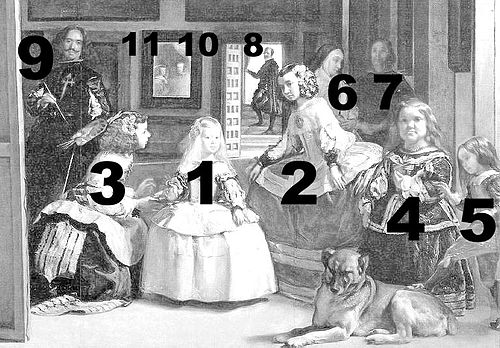
Key to the people represented: see text