Russian nationalism is a form of nationalism that promotes Russian cultural identity and unity. Russian nationalism first rose to prominence as a Pan-Slavic enterprise during the 19th century Russian Empire, and was repressed during the early Bolshevik rule. Russian nationalism was briefly revived through the policies of Joseph Stalin during and after the Second World War, which shared many resemblances with the worldview of early Eurasianist ideologues.
The Millennium of Russia monument built in 1862 that celebrated one-thousand years of Russian history.
Allegory of triune All-Russian nation that views the Russian nation as having three sub-nations within it: Great Russians (those commonly identified as ethnic Russians today), Little Russians (Ukrainians), and White Russians (Belarusians) from an early 20th century poster.
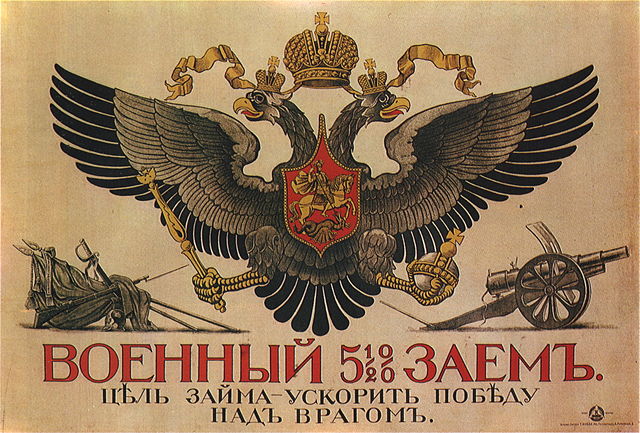
Russian World War I era poster calling to buy war bonds.
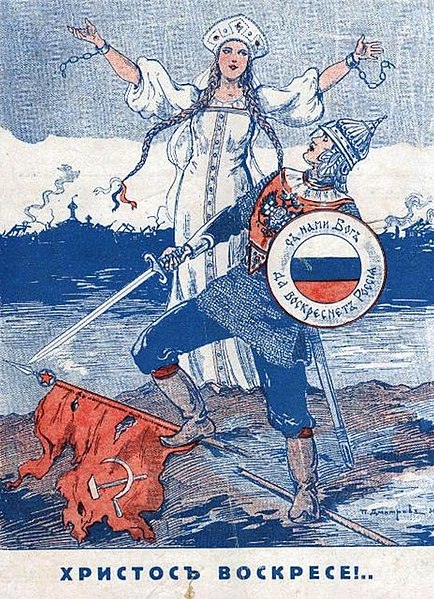
White Russian anti-Soviet poster, c. 1932, depicting the female personification of Russia known as Mother Russia.
Eurasianism is a socio-political movement in Russia that emerged in the early 20th century under the Russian Empire, which states that Russia does not belong in the "European" or "Asian" categories but instead to the geopolitical concept of Eurasia governed by the "Russian world", forming an ostensibly standalone Russian civilization.
Appropriation of Joseph Stalin and neo-Stalinism are key features in Eurasianism. Neo-Eurasianist ideologue Aleksandr Dugin described Stalin as the "greatest personality in Russian history" who represented "the spirit of Soviet society and the Soviet people".