Ruthenium
Videos
Ruthenium is a chemical element; it has symbol Ru and atomic number 44. It is a rare transition metal belonging to the platinum group of the periodic table. Like the other metals of the platinum group
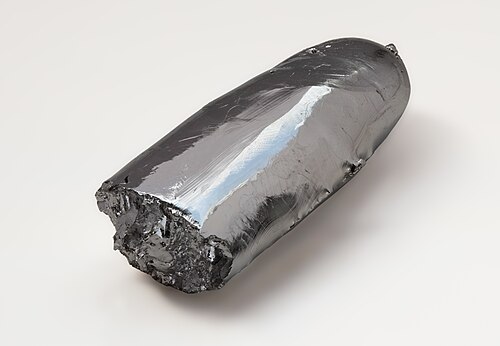
Ruthenium a half bar

Gas-phase-grown crystals of ruthenium metal

Tris(bipyridine)ruthenium(II) chloride
Technetium
Videos
Technetium is a chemical element; it has symbol Tc and atomic number 43. It is the lightest element whose isotopes are all radioactive. Technetium is one of only two radioactive elements both preceded
Ruthenium
…the final electron is in a lower shell). This anomaly, which has no effect on chemical properties, is also observed in all other elements (except technetium) in the range of Z = 41–45. Ruthenium has four crystal modifications and does not tarnish at ambient conditions; it oxidizes upon heating to 800 °C…

Technetium-99 electroplated onto a strip of gold foil

Periodisches System der Elemente (Periodic system of the elements) (1904–1945, now at the Gdańsk University of Technology): lack of elements: polonium 84Po (though discovered as early as in 1898 by Maria Sklodowska-Curie), astatine 85At (1940, in Berkeley), francium 87Fr (1939, in France), neptunium 93Np (1940, in Berkeley) and other actinides and lanthanides. Uses old symbols for: argon 18Ar (here: A), technetium 43Tc (Ma, masurium), xenon 54Xe (X),

Chloro-containing coordination complexes of technetium (99Tc) in various oxidation states: Tc(III), Tc(IV), Tc(V), and Tc(VI) represented.

The first technetium-99m generator, unshielded, 1958. A Tc-99m pertechnetate solution is being eluted from Mo-99 molybdate bound to a chromatographic substrate