S-Series (rocket family)
Videos
Photos
S-Series is a fleet of sounding rockets funded by the Japan Aerospace Exploration Agency (JAXA) that have been in service since the late 1960s. Manufactured by IHI Aerospace and operated by the Institute of Space and Astronautical Science (ISAS). The nomenclature of the S-Series rockets is the number of "S"s indicates the number of stages, and the following number details the diameter of the craft in millimeters. For example, the S-310 is a single stage rocket with a diameter of 310 mm.

Comparison of Japanese sounding rockets

S-160 Rocket (S-160JA-1). Exhibit in the National Museum of Nature and Science, Tokyo

A full-scale model of the S-310 rocket No.1 set on a launcher. (JAXA/ISAS Uchinoura Space Center KS Center)
Sounding rocket
Videos
Photos
A sounding rocket or rocketsonde, sometimes called a research rocket or a suborbital rocket, is an instrument-carrying rocket designed to take measurements and perform scientific experiments during its sub-orbital flight. The rockets are used to launch instruments from 48 to 145 km above the surface of the Earth, the altitude generally between weather balloons and satellites; the maximum altitude for balloons is about 40 km and the minimum for satellites is approximately 121 km. Certain sounding rockets have an apogee between 1,000 and 1,500 km, such as the Black Brant X and XII, which is the maximum apogee of their class. Sounding rockets often use military surplus rocket motors. NASA routinely flies the Terrier Mk 70 boosted Improved Orion, lifting 270–450-kg (600–1,000-pound) payloads into the exoatmospheric region between 97 and 201 km.
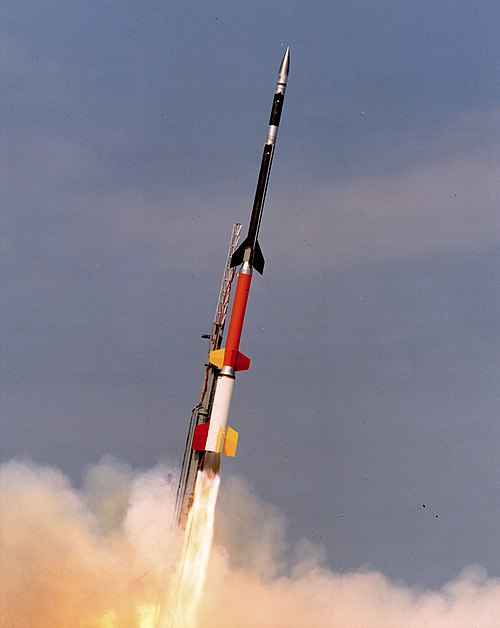
A Black Brant XII being launched from Wallops Flight Facility

Sample payloads for sounding rockets

A Loki-Dart (foreground) on display at the White Sands Missile Range rocket garden