SVT-40
Videos
The SVT-40 is a semi-automatic battle rifle developed in the Soviet Union that saw widespread service during and after World War II. It was intended to be the new service rifle of the Soviet Red Army.

Soviet soldiers with SVT-40 rifles.
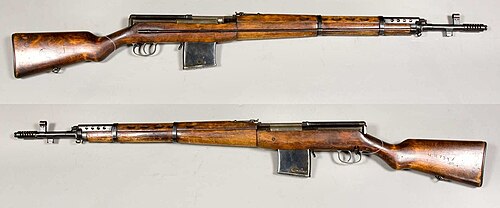
SVT-38

SVT-40

Estonian soldier with an SVT-40 in Finland, 1944
7.62×54mmR
Videos
The 7.62×54mmR is a rimmed rifle cartridge developed by the Russian Empire and introduced as a service cartridge in 1891. Originally designed for the bolt-action Mosin–Nagant rifle, it was used during
SVT-40
…SVT-38, SVT-40 Specifications Mass 3.85 kilograms (8.5 lb) unloaded Length 1,226 millimetres (48.3 in) Barrel length 625 millimetres (24.6 in) Cartridge 7.62×54mmR Action Gas-operated short-stroke piston, tilting bolt Muzzle velocity 830–840 m/s (2,720–2,760 ft/s) (light bullet arr. 1908) Effective firing range…

Examples of 7.62×54mmR rimmed ammunition. The photo shows, reading from left to right: Sellier & Bellot hollow-point boat tail; "Czech silver tip", mild steel core, light ball; Hungarian silver/yellow-tip, mild steel core, heavy ball; Wolf Ammunition gold soft-point; USSR 1986 steel-core light ball, Factory 60; Yugoslav surplus (1953); USSR 1940s lead-core light ball

Soviet World War II-era service cartridges: (Left to right) 7.62×54mmR, 7.62×39mm, 7.62×25mm

Modern service rifle cartridge cases: (Left to right) 7.62×54mmR, 7.62×51mm NATO, 7.62×39mm, 5.56×45mm NATO, 5.45×39mm

From left to right: L type bullet with lead core, LPS bullet with steel core aside, green tip T-46M tracer with tracer cup (opened both at top and bottom) and lead tip aside, T-46 tracer with extended cup (opened only at the bottom). All bullet jackets and tracer cups are made from copper washed steel.