Safety lamp
Videos
A safety lamp is any of several types of lamp that provides illumination in places such as coal mines where the air may carry coal dust or a build-up of flammable gases, which may explode if ignited,

Spedding mill at the German mining museum, Bochum, Northrhine-Westfalia, Germany

A worker cutting glass for mining lamps, September 1918
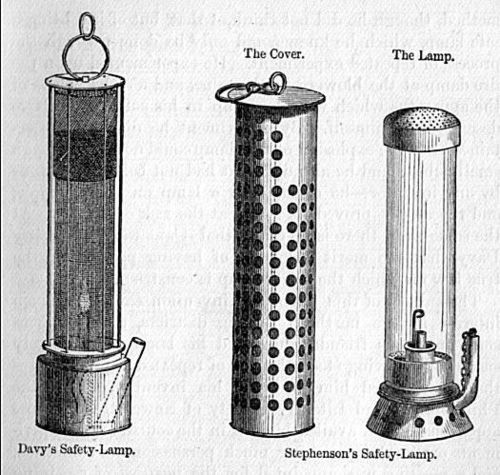
Early form of Stephenson lamp shown with a Davy lamp on the left

Mueseler lamp (on the left) and a derivative of the Geordie
Geordie lamp
Videos
The Geordie lamp was a safety lamp for use in flammable atmospheres, invented by George Stephenson in 1815 as a miner's lamp to prevent explosions due to firedamp in coal mines.
Safety lamp
…burning of the incoming firedamp passing back through the inlet. In the Geordie lamp, the inlet and exhausts are kept separate. Restrictions in the inlet ensure that only just enough air for combustion passes through the lamp. A tall…

Plate 1 and descriptive text for this, and plate 2, from page 32-33 of Report Upon the Claims of Mr. George Stephenson, Relative to the Invention of His Safety Lamp, by the Committee Appointed at a Meeting Holden in Newcastle November 1st 1817

George Stephenson's safety lamp as drawn in 1817.