Salatura
Videos
Śalātura was the birthplace of ancient Indian Sanskrit grammarian Pāṇini, regarded as the earliest known grammarian whose work has survived into modern times. In an inscription by Siladitya VII of Val
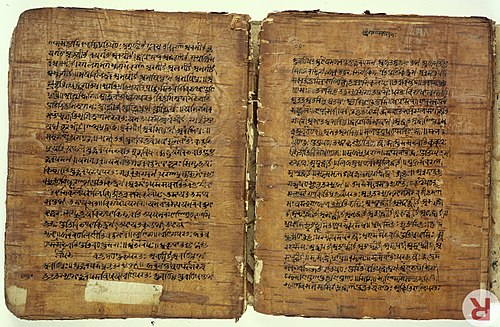
A 17th-century birch bark manuscript of a text based on Pāṇini's grammar from Kashmir

Xuan Zang Statue at Longmen Grottoes, Luoyang, China
Xuanzang
Videos
Xuanzang, born Chen Hui or Chen Yi, also known by his Sanskrit Dharma name Mokṣadeva, was a 7th-century Chinese Buddhist monk, scholar, traveller, and translator. He is known for the epoch-making cont
Salatura
…20 miles northwest of the Attock Bridge. According to the CE 646 book Great Tang Records on the Western Regions (大唐西域記) of 7th-century Chinese scholar Xuanzang, there was a town called Suoluoduluo on the Indus where Pāṇini was born, and he composed the Qingming-lun (Sanskrit: Vyākaraṇa). He mentioned that a…

14th-century painting of Xuanzang – Japan, Kamakura period

Liao dynasty statue of the Eleven Headed Guanyin in Dule Temple in Tianjin, China.

Xuanzang describes colossal Buddhas carved into the rocks of Bamiyan region (above: 19th-century sketch, destroyed by the Taliban in 2001).

Reconstructed route of Xuanzang over 629–645 CE through India. Along with Nalanda in Bihar, he visited locations that are now in Kashmir, Gujarat, Madhya Pradesh, Odisha, Tamil Nadu, and Bangladesh.