Samuel de Champlain
Videos
Samuel de Champlain was a French explorer, navigator, cartographer, soldier, geographer, diplomat, and chronicler who founded Quebec City and established New France as a permanent French colony in Nor
Detail from "Défaite des Iroquois au Lac de Champlain", Champlain Voyages (1613). This self-portrait is the only surviving contemporary likeness of the explorer.

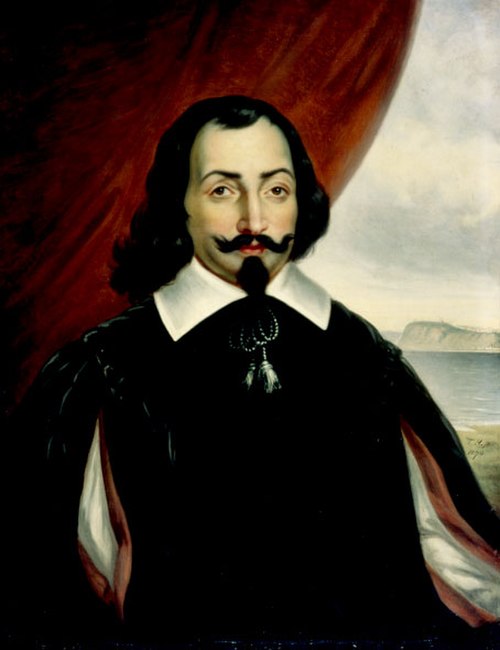
Inauthentic depiction of Champlain, by Théophile Hamel (1870), after the one by Ducornet, based on a portrait of Michel Particelli d'Émery by Balthasar Moncornet. No authentic portrait of Champlain is known to exist.

Sir Sandford Fleming Park, Halifax, Nova Scotia – Stone from Samuel de Champlain's birthplace in Brouage, France (1574)

Champlain and guide in Isle La Motte, Vermont, at the site Champlain is said to have first set foot in Vermont (and encamped) in 1609. Lake Champlain is in the background. (Sculptor E.L.Weber, 1967; Photo by Matt Wills, 2009)
Pierre Dugua, Sieur de Mons
Videos
Pierre Dugua de Mons was a French merchant, explorer and colonizer. A Calvinist, he was born in the Château de Mons, in Royan, Saintonge and founded the first permanent French settlement in Canada. He
Bust of Pierre Dugua de Mons in Quebec City by Hamilton MacCarthy; installed on July 3, 2007, it is an exact copy of the one in Annapolis Royal, Nova Scotia.
