Sangha
Videos
Saṅgha or saṃgha is a term meaning "association", "assembly", "company" or "community". In a political context, it was historically used to denote a governing assembly in a republic or a kingdom, and

Monks, Tibetan Buddhist monastery, Rato Dratsang, India, January 2015

Sangha, Luang Prabang, Laos

Shakyamuni Buddha and his followers, holding begging bowls, receive offerings. An 18th-century Burmese watercolor.

Upāsakas and Upāsikās performing a short chanting ceremony at Three Ancestors Temple, Anhui, China
Bhikkhu
Videos
A bhikkhu is an ordained male in Buddhist monasticism. Male and female monastics are members of the Sangha.
Sangha
…the tradition of the sangha represents humanity's oldest surviving democratic institution. In Buddhism, sangha refers to the monastic communities of bhikkhu (monks) and bhikkhuni (nuns). These communities are traditionally referred to as the bhikkhu-sangha or the bhikkhuni-sangha. As a separate category…

Bhikkhus in Phutthamonthon, Thailand

One of the earliest Western Buddhist monks, Ven Nyanatiloka Mahathera from Germany

Theravadin monks at Abhayagiri Buddhist Monastery in United States
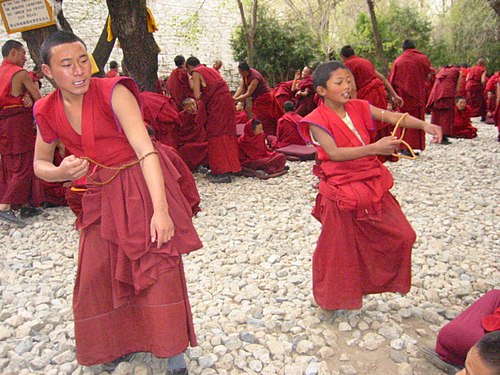
Tibetan monks, all of whom ordain under the Mulasarvastivada Vinaya