Sans-culottes
Videos
The sans-culottes were the common people of the lower classes in late 18th-century France, a great many of whom became radical and militant partisans of the French Revolution in response to their poor
Simon Chenard as a Sans-Culotte by Louis-Léopold Boilly, c. 1792


A sans-culotte with a halberd, by Jean-Baptiste Lesueur

François Hanriot chef de la section des Sans-Culottes (Rue Mouffetard); drawing by Gabriel in the Carnavalet Museum

The uprising of the Parisian sans-culottes from 31 May to 2 June 1793. The scene takes place in front of the Deputies Chamber in the Tuileries. The depiction shows Marie-Jean Hérault de Séchelles and Pierre Victurnien Vergniaud.
Jean-Paul Marat
Videos
Jean-Paul Marat was a French political theorist, physician, and scientist. A journalist and politician during the French Revolution, he was a vigorous defender of the sans-culottes, a radical voice, a
Sans-culottes
…at a time when, it could not be foreseen, that the name which honoured the followers of Washington would afterwards be assumed by the satellites of a Marat and a Robespierre". The most fundamental political ideals of the sans-culottes were social equality, economic equality, and popular democracy. They…

Portrait by Joseph Boze, 1793

Commemorative plaque on the house where Marat was born, in Boudry in Switzerland

Marat by Jean-François Garneray
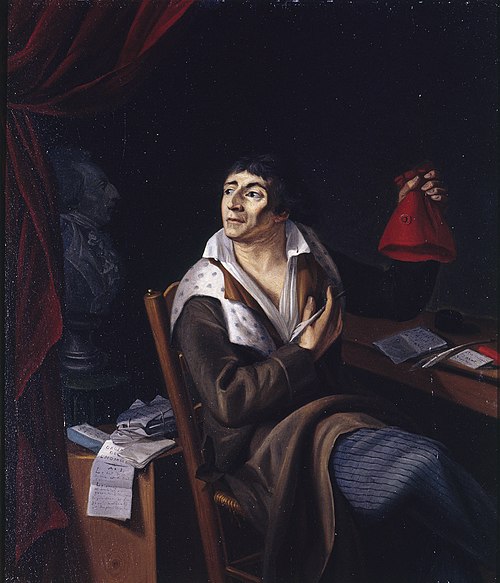
Anonymous portrait of Marat, c. 1793 (Musée Carnavalet)