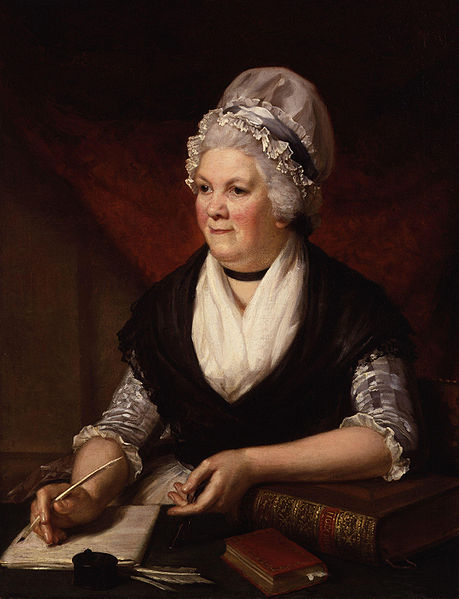
Sarah Trimmer was a writer and critic of 18th-century British children's literature, as well as an educational reformer. Her periodical, The Guardian of Education, helped to define the emerging genre by seriously reviewing children's literature for the first time; it also provided the first history of children's literature, establishing a canon of the early landmarks of the genre that scholars still use today. Trimmer's most popular children's book, Fabulous Histories, inspired numerous children's animal stories and remained in print for over a century.
Sarah Trimmer painted by Henry Howard
Sarah Trimmer's Sunday School in Brentford
Title page from the first edition of Trimmer's Fabulous Histories (1786)
From Trimmer's A Description of a Set of Prints Taken from the New Testament: "Jesus spake unto them, saying, It is I, be not afraid. And Peter answered and said Lord, if it be thou, bid me come to thee on the water: and he said, Come. And when Peter was come out of the ship, he (through the power of CHRIST) walked on the water likewise; but when he saw the wind boisterous, his faith or belief in CHRIST'S power, failed, he was afraid, and beginning to sink, he cried out, Lord, save me! And immediately JESUS stretched forth his hand and caught him, saying, O thou of little faith, wherefore didst thou doubt?"
The Guardian of Education
The Guardian of Education was the first successful periodical dedicated to reviewing children's literature in Britain. It was edited by 18th-century educationalist, children's author, and Sunday school advocate Sarah Trimmer and was published from June 1802 until September 1806 by J. Hatchard and F. C. and J. Rivington. The journal offered child-rearing advice and assessments of contemporary educational theories, and Trimmer even proffered her own educational theory after evaluating the major works of the day.
Sarah Trimmer, editor of The Guardian of Education, painted by Henry Howard in 1798
Jean-Jacques Rousseau, author of Emile (1762), one of the most influential books of educational philosophy in the eighteenth century
Trimmer opposed graphic illustrations, such as this one of "Blue Beard" from the 1697 French edition of Perrault's tales.
Title page from Sarah Fielding's The Governess, or The Little Female Academy (1749), cited by Trimmer as a landmark in the history of children's literature