Saxe-Weimar
Videos
Saxe-Weimar was one of the Saxon duchies held by the Ernestine branch of the Wettin dynasty in present-day Thuringia. The chief town and capital was Weimar. The Weimar branch was the most genealogical

Schloss Weimar, the ducal residence
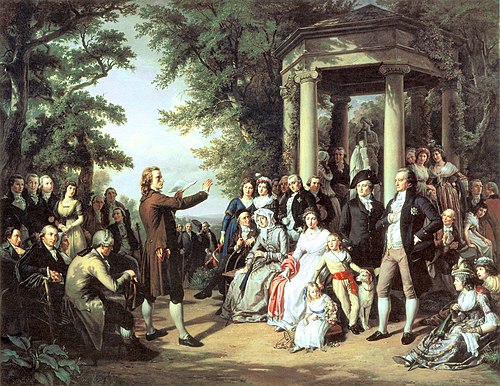
Theobald von Oer: The Weimar Court of the Muses (1860); Schiller reads at Schloss Tiefurt, Wieland, Herder and Goethe among the listeners

Arms of Saxe-Weimar displayed in Buttstädt
Saxe-Weimar-Eisenach
Videos
Saxe-Weimar-Eisenach was a German state, created as a duchy in 1809 by the merger of the Ernestine duchies of Saxe-Weimar and Saxe-Eisenach, which had been in personal union since 1741. It was raised
Saxe-Weimar
…the Rhine in 1806. In 1809, Saxe-Weimar and Saxe-Eisenach, which had been united only in the person of the duke, were formally merged into the Duchy of Saxe-Weimar-Eisenach. Johann Wilhelm (1554–1573…

Schloss Weimar, the ducal palace

Wartburg Castle near Eisenach

The former Ducal Palace of Eisenach, finished in 1748 by Ernest Augustus I, Duke of Saxe-Weimar-Eisenach

Grand Duke Charles Alexander (1853–1901). He joined the German Empire with his duchy in 1871 and rebuilt the world-famous Wartburg as a national monument.