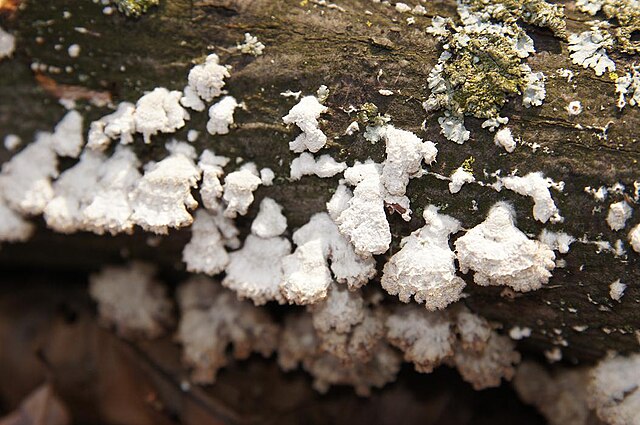
Schizophyllum commune is a species of fungus in the genus Schizophyllum. The mushroom resembles undulating waves of tightly packed corals or loose Chinese fan. "Gillies" or "split gills" vary from creamy yellow to pale white in colour. The cap is small, 1–4 centimetres wide with a dense yet spongey body texture. It is known as the split-gill mushroom because of the unique longitudinally divided nature of the "gills" on the underside of the cap. This mushroom is found throughout the world.
Schizophyllum commune
Schizophyllum commune in the Santa Cruz Mountains of California
Schizophyllum commune Elk Grove, Illinois
Schizophyllum commune in Missouri, US
Fungi are a diverse group of organisms that employ a huge variety of reproductive strategies, ranging from fully asexual to almost exclusively sexual species. Most species can reproduce both sexually and asexually, alternating between haploid and diploid forms. This contrasts with most multicellular eukaryotes such as mammals, where the adults are usually diploid and produce haploid gametes which combine to form the next generation. In fungi, both haploid and diploid forms can reproduce – haploid individuals can undergo asexual reproduction while diploid forms can produce gametes that combine to give rise to the next generation.
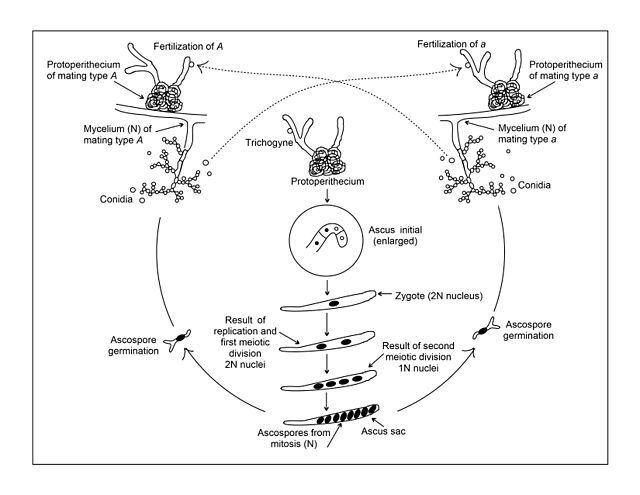
Neurospora crassa life cycle. The haploid mycelium reproduces asexually by two processes: (1) simple proliferation of existing mycelium, and (2) formation of conidia (macro- and micro-) which can be dispersed and then germinate to produce new mycelium. In the sexual cycle, mating can only occur between individual strains of different mating type, A and a. Fertilization occurs by the passage of nuclei of conidia or mycelium of one mating type into the