Schools of Buddhism
Videos
The schools of Buddhism are the various institutional and doctrinal divisions of Buddhism, which are based on various differences, such as geography, historical schisms and sectarianism, and the diffe

Representatives from the three major modern Buddhist traditions, at the World Fellowship of Buddhists, 27th General Conference, 2014.

The Tipitaka (Pali Canon), in a Thai Style book case. The Pali Tipitaka is the doctrinal foundation of all major Theravāda sects today

Nagarjuna, one of the most influential thinkers of Indian Mahāyāna Buddhism

Indian Buddhist Mahasiddhas, 18th century, Boston MFA.
Mahayana
Videos
Mahāyāna is the largest branch of Buddhism, followed by the older branch Theravada. It is a broad group of Buddhist traditions, texts, philosophies, and practices that developed in various regions and
Schools of Buddhism
…extent in most of Western academia, Buddhism is separated into two groups: Theravāda (lit. 'the Teaching of the Elders' or 'the Ancient Teaching'), and Mahāyāna (lit. 'the Great Vehicle'). The most common classification among scholars is threefold: Theravāda, Mahāyāna and Vajrayāna. Another common division is…

The Five Buddhas in Shishoin Temple (Tokyo). Mahāyāna holds there are multiple buddhas which one can interact with. These buddhas are also able to send manifestations to our world to teach and guide beings.

Mahāyāna Buddhist triad, including Bodhisattva Maitreya, the Buddha, and Bodhisattva Avalokiteśvara. 2nd–3rd century CE, Gandhāra
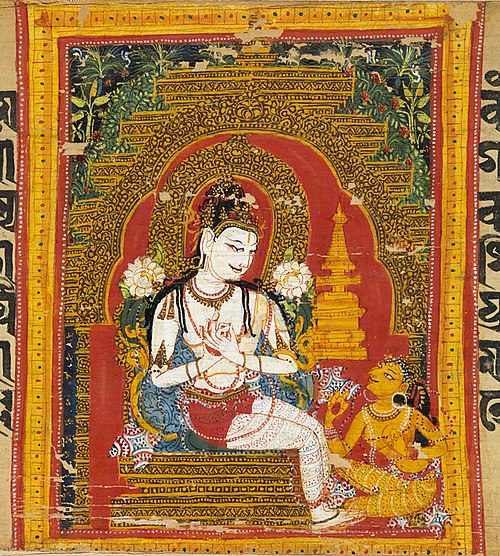
An illustration in a manuscript of the Aṣṭasāhasrikā Prajñāpāramitā Sūtra from Nalanda, depicting the bodhisattva Maitreya, an important figure in Mahāyāna

Seated Avalokiteshvara bodhisattva. Gandharan, from Loriyan Tangai. Kushan period, 1st – 3rd century CE. Indian Museum, Calcutta