A seal, in an East and Southeast Asian context, is a general name for printing stamps and impressions thereof which are used in lieu of signatures in personal documents, office paperwork, contracts, art, or any item requiring acknowledgement or authorship. On documents they were usually used to print an impression using a pigmented paste or ink, unlike the wax impression commonly used in Europe.
Personal seal and monogram (huaya) of the Chongzhen Emperor (1611-1644)
The seal works of Wu Qiuyan in Yuan dynasty
Chinese seal and red seal paste.
Yinnihe (seal paste box), Ming dynasty.
A signature is a handwritten depiction of someone's name, nickname, or even a simple "X" or other mark that a person writes on documents as a proof of identity and intent. The writer of a signature is a signatory or signer. Similar to a handwritten signature, a signature work describes the work as readily identifying its creator. A signature may be confused with an autograph, which is chiefly an artistic signature. This can lead to confusion when people have both an autograph and signature and as such some people in the public eye keep their signatures private whilst fully publishing their autograph.
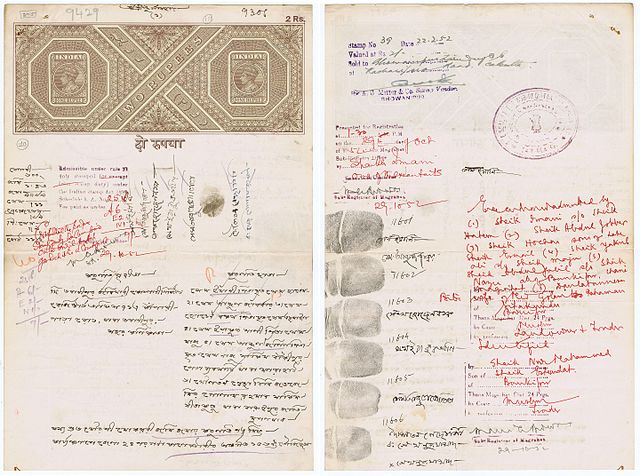
Fingerprints may be used instead of signatures where the signer is illiterate. Here on an Indian legal document of 1952.