Second Battle of Ypres
Videos
The Second Battle of Ypres was fought from 22 April to 25 May 1915, during the First World War, for control of the tactically valuable high ground to the east and the south of the Flemish town of Ypre
German diagram showing the new front line after the 2nd Battle of Ypres


The First German Gas Attack at Ypres by William Roberts depicting the German gas attack on French and Canadian soldiers

Langemark-Poelkapelle: Photograph taken from a position just west of Langemark German war cemetery, facing approximately north, towards the former location of the German trench from which the first gas attack was launched on 22 April 1915. In this area, the German trench system ran approximately from the farmhouse on the left to the group of willow trees on the right.

George Nasmith, the head of the field laboratory for the Canadian Expeditionary Force, advised a Canadian field ambulance officer to pass the order to use urine to counteract the gas.
In Flanders Fields
Videos
"In Flanders Fields" is a war poem in the form of a rondeau, written during the First World War by Canadian physician Lieutenant-Colonel John McCrae. He was inspired to write it on May 3, 1915, after
Second Battle of Ypres
…Saint Julien Memorial in the village. During the Second Battle of Ypres, Lieutenant colonel John McCrae, Medical Officer of the 1st Brigade CFA, wrote "In Flanders Fields" in the voice of those who perished in the war. Published in Punch 8 December 1915, the poem is still recited on Remembrance Day and Memorial Day. Lance…

Inscription of the complete poem in a bronze book at the John McCrae memorial at his birthplace in Guelph, Ontario

Lieutenant Colonel John McCrae was a soldier, physician and poet.

Aspects of the poem were used in propaganda, such as this Canadian war bonds poster
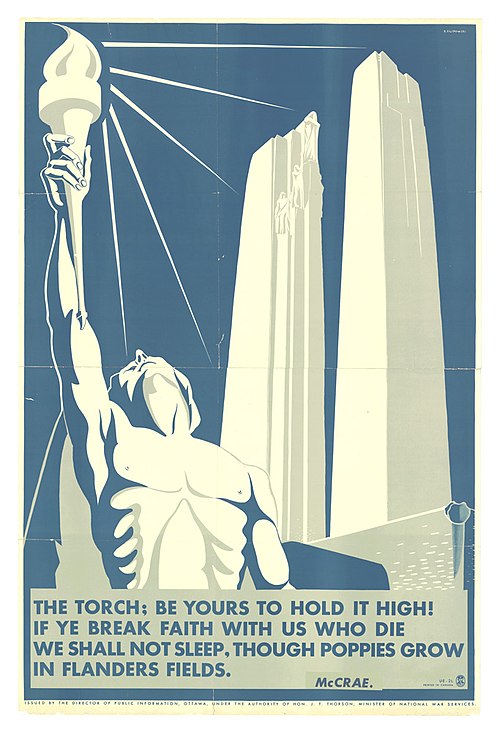
The Vimy Memorial and part of "In Flanders Fields" on a Second World War recruitment poster