The second round of Chinese character simplification was an aborted script reform promulgated on 20 December 1977 by the People's Republic of China. It was intended to replace the first round of simpl
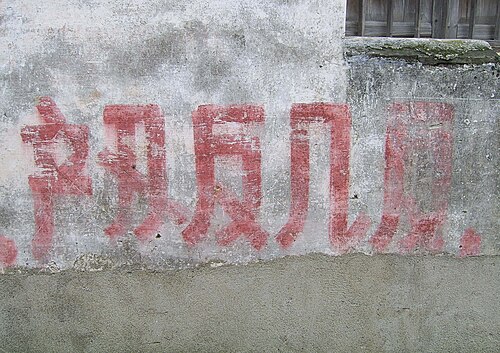
The writing on this wall says "产量翻几番"/"產量翻幾番" ('production output will increase multiple times'), but uses non-standard characters. During the Cultural Revolution, such sights were common as citizens were encouraged to innovate and participate in the character simplification process.

A sign reading "仃车往右" ('parking lot to the right'), which, instead of using 停, uses 仃, one of the most successfully survived second-round characters now.

A playful name for a restaurant in Shanghai that says "一佳歺厅" homophonous to "一家餐厅" (a restaurant).

Sec Sim Chinesetexttest
Pinyin
Videos
The Chinese Phonetic Alphabet, commonly called Hanyu Pinyin or simply pinyin, is the most common romanization system for Standard Chinese. Hanyu literally means 'Han language' — that is, the Chinese l
Second round of simplified Chinese characters
…retracted the Second Scheme emphasized that future reforms should proceed with caution. It also "explicitly precluded any possibility of developing Hanyu Pinyin as an independent writing system (wénzì)." The focus of language planning policy in China following the conference shifted from simplification and…

A facade of a kindergarten in Zhengzhou, Henan, with writing using simplified characters and pinyin

A slogan written on a school wall featuring pinyin annotations without tonal marks or word grouping