Sengge Zangbo
Videos
Photos
Sengge Zangbo,
Sengge Khabab or Shiquan He is a river in the Ngari Prefecture in the Tibet Autonomous Region, China that is the source stream of the Indus river, one of the major trans-Himalayan rivers of Central and South Asia. The river rises in the mountain springs north of the Manasarovar lake, and 300 km (190 mi) downstream joins the Gar Tsangpo river near the village of Tashigang. Although it is thereafter called the Indus internationally, the Tibetans continue to regard the combined river to be Sênggê Zangbo as it flows into Ladakh.

Chizuo Tsangpo, a tributary of Sengge Zangbo, near its confluence
Indus River
Videos
Photos
The Indus is a transboundary river of Asia and a trans-Himalayan river of South and Central Asia. The 3,120 km (1,940 mi) river rises in mountain springs northeast of Mount Kailash in Western Tibet, flows northwest through the disputed region of Kashmir, bends sharply to the left after the Nanga Parbat massif, and flows south-by-southwest through Pakistan, before emptying into the Arabian Sea near the port city of Karachi.

The Indus Gorge is formed as the Indus River bends around the Nanga Parbat massif, shown towering behind, defining the western anchor of the Himalayan mountain range.

The course and major tributaries of the Indus river

The course of the Indus in the heavily disputed Kashmir region; the river flows through Ladakh and Gilgit-Baltistan, administered respectively by India and Pakistan
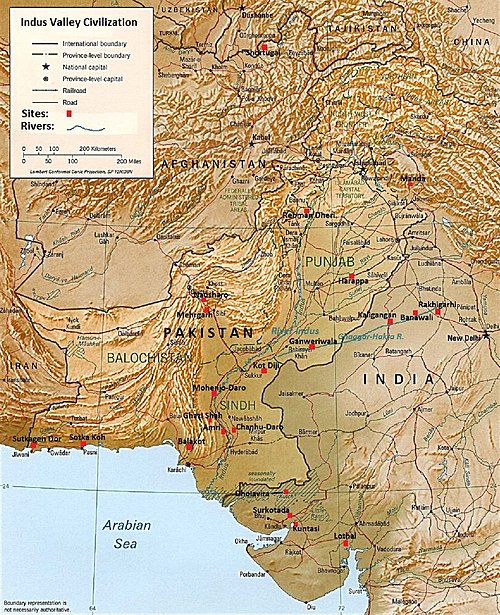
The major sites of the Indus Valley Civilization c. 2600–1900 BC in Pakistan, India and Afghanistan