Servilia (mother of Brutus)
Videos
Servilia was a Roman matron from a distinguished family, the Servilii Caepiones. She was the daughter of Quintus Servilius Caepio and Livia, thus the maternal half-sister of Cato the Younger. She marr

Image of the goddess Victory on a coin of 41 BC, thought to be modelled on Servilia.

A denarius of Marcus Junius Brutus issued after the assassination of Julius Caesar, Servilia's son and lover, respectively.
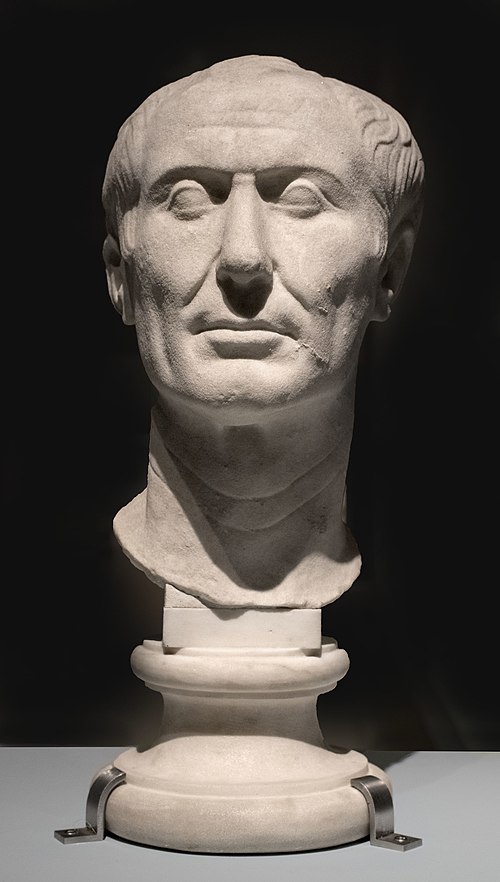
The Tusculum portrait, a contemporary Roman sculpture of Julius Caesar.

Servilia presents her daughter Junia Tertia to Caesar, illustration by Pierre-François Hugues d'Hancarville, 1780
Cato the Younger
Videos
Marcus Porcius Cato Uticensis, also known as Cato the Younger, was an influential conservative Roman senator during the late Republic. A staunch advocate for liberty and the preservation of the Republ
Servilia (mother of Brutus)
…matron from a distinguished family, the Servilii Caepiones. She was the daughter of Quintus Servilius Caepio and Livia, thus the maternal half-sister of Cato the Younger. She married Marcus Junius Brutus, with whom she had a son, the Brutus who, along with others in the Senate, assassinated Julius Caesar. After her first…

Inscribed bronze bust from Volubilis, Morocco

Statue of Cato the Younger in the Louvre Museum. He is about to kill himself while reading the Phaedo, a dialogue of Plato which describes the death of Socrates. The statue was begun by Jean-Baptiste Roman (Paris, 1792–1835) using white Carrara marble. It was finished by François Rude (Dijon, 1784 – Paris, 1855).

The basilica Porcia was a small building to the left of the curia Hostilia (in red) in the Roman Forum raised by Cato's great-grandfather. It was Rome's first basilica; it burnt down in 52 BC.
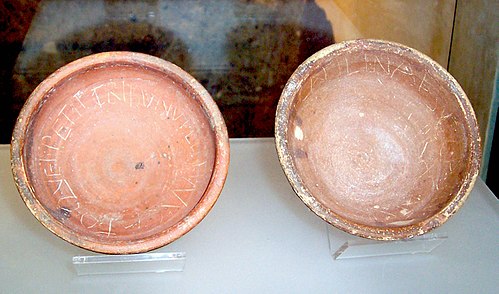
Propaganda cup of Cato (the cup to the left, the one to the right being dedicated to Catiline), for his canvass for the plebeian tribunate of 62 BC. These cups, filled with food or drinks, were distributed in the streets to the people, and bore an inscription supporting the candidate to the election.