Shilling (British coin)
Videos
The British shilling, abbreviated "1s" or "1/-", was a unit of currency and a denomination of sterling coinage worth 1⁄20 of one pound, or twelve pre-decimal pence. It was first minted in England in 1
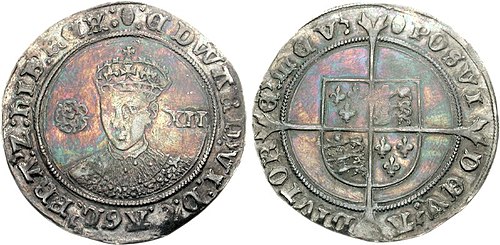
Shilling of Edward VI, struck between 1551 and 1553

A sampler in the Guildhall Museum of Rochester illustrates the conversion between pence and shillings, going up in units of ten old pennies.

Queen Victoria Shilling, 1838–1887. Engravers William Wyon and Jean Baptiste Merlen.

Queen Victoria Shilling, 1887–1889. Engravers Joseph Edgar Boehm and Leonard Charles Wyon.
Decimal Day
Videos
Decimal Day was Monday 15 February 1971, when the United Kingdom and Ireland decimalised their £sd currencies of pounds, shillings, and pence.
Shilling (British coin)
…as in "ten-bob note", also the Scout Association's Bob a Job Week. The shilling was last minted in 1966, prior to the UK's decimalisation. Following Decimal Day on 15 February 1971 the coin had a value of five new pence, and a new coin of the same value but labelled as "five new pence" (the word "new" was removed…

An introductory pack of the new currency

British decimalisation training stamps in the same colours and values as the upcoming decimal stamps

A "Decimal Adder"

Along with a few other non-circulating coins, sovereigns (including half, double and quintuple sovereigns) survived decimalisation, and remain legal tender to date, though they have far greater worth as bullion coins and as numismatic collectibles than their face value.