Shrove Tuesday
Videos
Shrove Tuesday is the final day of Shrovetide, which marks the end of the pre-Lenten season. Lent begins the following day with Ash Wednesday. Shrove Tuesday is observed in many Christian countries th

Pieter Bruegel the Elder: The Fight Between Carnival and Lent (detail), 1559
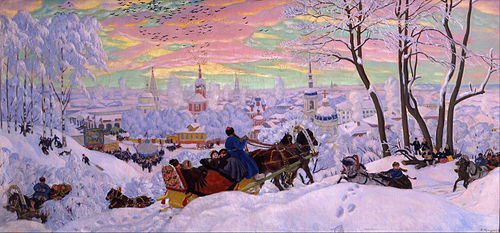
Russian artist Boris Kustodiev's Maslenitsa (1916)
![Shrove Tuesday, Bear guiding [pl] in Poland (1950)](https://upload.wikimedia.org/wikipedia/commons/thumb/4/41/Zapusty-w-Podmoklach-Wielkich_1950.jpg/500px-Zapusty-w-Podmoklach-Wielkich_1950.jpg)
Shrove Tuesday, Bear guiding [pl] in Poland (1950)

People in Alfta, Sweden, masquerading as Fettisdagsgubbar in traditional celebration of Shrove Tuesday.
Shrovetide
Videos
Shrovetide is the Christian liturgical period prior to the start of Lent that begins on Shrove Sunday and ends at the close of Shrove Tuesday. The season focuses on examination of conscience and repen
Shrove Tuesday
…Shrove Tuesday (also known as Mardi Gras, Pancake Tuesday, or Pancake Day) is the final day of Shrovetide, which marks the end of the pre-Lenten season. Lent begins the following day with Ash Wednesday. Shrove Tuesday is observed in many Christian countries…

During Shrovetide, and especially on Shrove Tuesday, many Christians confess their sins, in preparation for the somber season Lent. Shown is an Evangelical Lutheran confessional in Luther Church, Helsinki, Finland

Many Christian congregations celebrate Shrovetide through pancake breakfasts, which are held on Shrove Monday or Shrove Tuesday.

Church bells of Catholic, Lutheran and Anglican congregations ring on Shrove Tuesday (the Shriving Bell) reminding the faithful to confess their sins on Shrove Tuesday