Silk
Videos
Silk is a natural protein fiber, some forms of which can be woven or knitted into textiles. The protein fiber of silk is composed mainly of fibroin and a smaller coating of sericin. It is most commonl
Raw silk of domesticated silk worms, showing its natural shine


Four of the most important domesticated silk moths. Top to bottom: B. mori, Hyalophora cecropia, Antheraea pernyi, Samia cynthia. From Meyers Konversations-Lexikon (1885–1892)

Rearing of wild Eri silk worm, Assam

Woven silk textile from tomb no 1. at Mawangdui in China, from the Han dynasty, 2nd century BC
Bombyx mori
Videos
Bombyx mori, commonly known as the domestic silk moth, is a domesticated moth species belonging to the family Bombycidae. It is the closest relative of Bombyx mandarina, the wild silk moth. Silkworms
Silk
…20-25%). It is most commonly produced from the cocoons of certain insect larvae. The best-known silk is obtained from the cocoons of the larvae of the mulberry silkworm Bombyx mori, which are reared in captivity (sericulture). Harvested silk is produced by numerous insects; generally, only the silk of various moth…

Pairedmoths
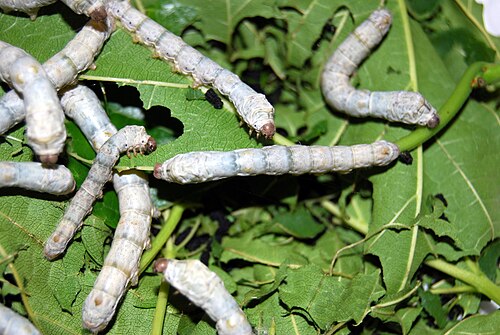
Silkworms 3000px

Adult silk moth

Cocoon of B. mori