Simchat Torah
Videos
Simchat Torah, also spelled Simhat Torah, is a Jewish holiday that celebrates and marks the conclusion of the annual cycle of public Torah readings, and the beginning of a new cycle. Simchat Torah is

The Feast of the Rejoicing of the Law at the Synagogue in Livorno by Solomon Hart, 1850. Jewish Museum, New York

Throwing cakes to children on Simḥat Torah, by Johann Leusden in Philologus Hebræo-Mixtus, Utrecht, 1657

Paper flag for Simchat Torah, 1900, in the collection of the Jewish Museum of Switzerland

Simchat Torah celebrated in the Israeli army with Shlomo Goren, 1969
Jewish holidays
Videos
Jewish holidays, also known as Jewish festivals or Yamim Tovim, are holidays observed by Jews throughout the Hebrew calendar. They include religious, cultural and national elements, derived from four
Simchat Torah
…and marks the conclusion of the annual cycle of public Torah readings, and the beginning of a new cycle. Simchat Torah is a component of the Biblical Jewish holiday of Shemini Atzeret ("Eighth Day of Assembly"), which follows immediately after the festival of Sukkot in the month of Tishrei (occurring in September…

Candles are lit on the eve of the Jewish Sabbath ("Shabbat") and on Jewish holidays.

Shabbat candles and kiddush cup
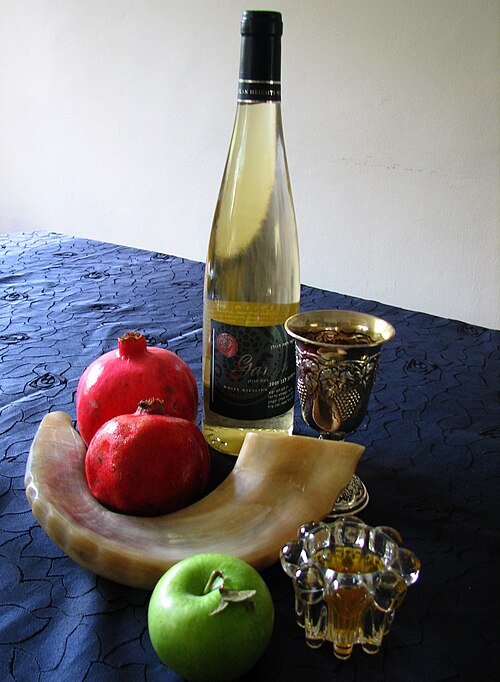
Rosh Hashana symbols: shofar, apples and honey, pomegranates, kiddush wine

A man in a tallit blows the shofar