Simon Grunau
Videos
Photos
Simon Grunau was the author of Preussische Chronik, the first comprehensive history of Prussia. The only personal information available is what he wrote himself in his work: that he was a Dominican priest from Tolkemit (Tolkmicko) near Frauenburg (Frombork) just north of Elbing (Elbląg) in the Monastic State of the Teutonic Order. He preached in Danzig (Gdańsk) and claimed to have met Pope Leo X and Polish King Sigismund I the Old. The chronicle was written in the German language sometime between 1517 and 1529. Its 24 chapters deal with Prussian landscape, agriculture, inhabitants, their customs, and history from earliest times to up to 1525 when the Protestant Duchy of Prussia was created. It also contains a short vocabulary of the Prussian language, one of the very few written artifacts of this extinct language. While often biased and based on dubious sources, this work became very popular and is the principal source of information on Prussian mythology. The chronicle circulated as a frequently copied manuscript and was first published in 1876. Modern historians often dismiss the Preussische Chronik as a work of fiction.

The so-called Flag of Widewuto was introduced by Grunau
Old Prussian language
Videos
Photos
Old Prussian was a West Baltic language belonging to the Baltic branch of the Indo-European languages, which was once spoken by the Old Prussians, the Baltic peoples of the Prussian region. The language is called Old Prussian to avoid confusion with the German dialects of Low Prussian and High Prussian and with the adjective Prussian as it relates to the later German state. Old Prussian began to be written down in the Latin alphabet in about the 13th century, and a small amount of literature in the language survives.
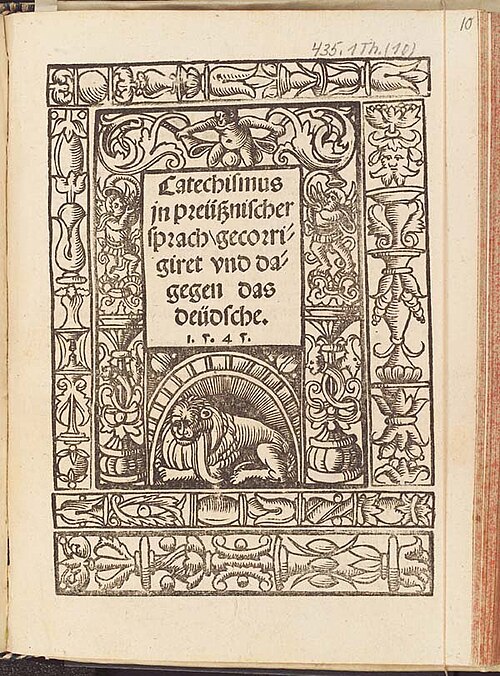
Catechism in Old Prussian from 1545

The Prussian post-folk band Kellan performing at the Baltic culture festival Mėnuo Juodaragis in Lithuania

The epigram of Basel – oldest known inscription in Prussian language and Baltic language in general, middle of 14th century