Sirius
Videos
Sirius is the brightest star in the night sky, located in the southern constellation of Canis Major. Its name is derived from the Greek word Σείριος. The star is designated α Canis Majoris, Latinized
Hubble Space Telescope image of Sirius A and Sirius B. The white dwarf can be seen to the lower left. The diffraction spikes and concentric rings are instrumental effects. Sirius A is approximately one thousand times brighter than Sirius B.

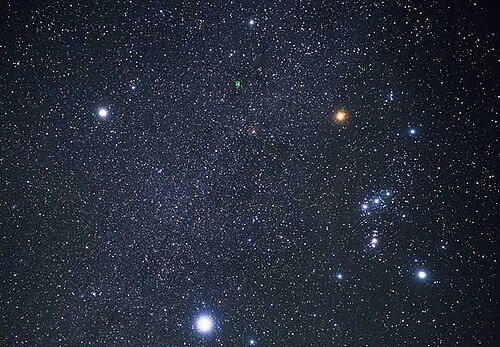
Sirius (bottom) and the constellation Orion (right). The three brightest stars in this image—Sirius, Betelgeuse (top right) and Procyon (top left)—form the Winter Triangle. The bright star at top center is Alhena, which forms a cross-shaped asterism with the Winter Triangle.

The constellations Canis Major (left) and Orion as seen with the naked eye. Sirius, left of centre, is the brightest star.

A Chandra X-ray Observatory image of the Sirius star system, where the spike-like pattern is due to the support structure for the transmission grating. The brighter source is Sirius B. Credit: NASA/SAO/CXC
White dwarf
Videos
A white dwarf is a very dense type of star: in an Earth-sized volume, it packs a mass that is comparable to the Sun. A white dwarf radiates light from residual heat and eventual crystallization, not f
Sirius
…Canopus, the next brightest star. Sirius is a binary star consisting of a main-sequence star of spectral type A0 or A1, termed Sirius A, and a faint white dwarf companion of spectral type DA2, termed Sirius B. The distance between the two varies between 8.2 and 31.5 astronomical units as they orbit every 50…

Artist's impression of debris around a white dwarf

Comet falling into white dwarf (artist's impression)

Artist’s impression of WD 1856b

Artist's impression of the WD J0914+1914 system