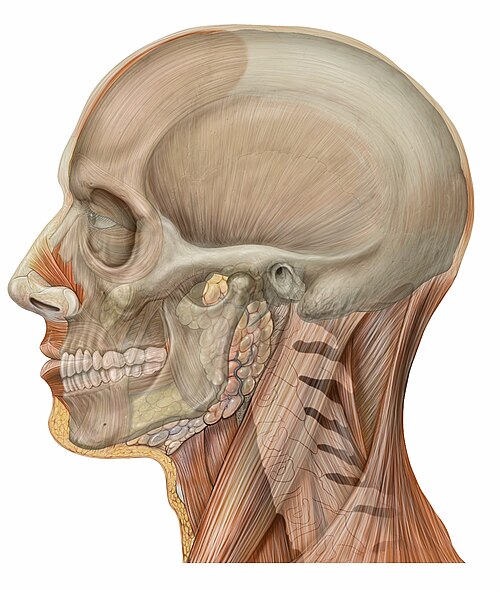
The skull is a bone protective cavity for the brain. The skull is composed of four types of bone i.e., cranial bones, facial bones, ear ossicles and hyoid bone, however two parts are more prominent: the cranium and the mandible. In humans, these two parts are the neurocranium (braincase) and the viscerocranium that includes the mandible as its largest bone. The skull forms the anterior-most portion of the skeleton and is a product of cephalisation—housing the brain, and several sensory structures such as the eyes, ears, nose, and mouth. In humans, these sensory structures are part of the facial skeleton.
Fish head parts, 1889, Fauna of British India, Sir Francis Day
Cephalization is an evolutionary trend in animals that, over many generations, the special sense organs and nerve ganglia become concentrated towards the rostral end of the body where the mouth is located, often producing an enlarged head. This is associated with the animal's movement direction and bilateral symmetry, and cephalization of the nervous system led to the formation of a functional centralized brain in three groups of bilaterian animals, namely the arthropods, cephalopod molluscs, and vertebrates (craniates).
A lobster is heavily cephalized, with eyes, antennae, multiple mouthparts, claws, and the brain (inside the armoured exoskeleton), all concentrated at the animal's head end.
The yellow papillae flatworm, Thysanozoon nigropapillosum, is somewhat cephalized, with a distinct head end (at right) which has pseudotentacles and an eyespot.