Slate industry in Wales
Videos
The existence of a slate industry in Wales is attested since the Roman period, when slate was used to roof the fort at Segontium, now Caernarfon. The slate industry grew slowly until the early 18th century, then rapidly during the Industrial Revolution in Wales until the late 19th century, at which time the most important slate producing areas were in northwest Wales. These sites included the Penrhyn Quarry near Bethesda, the Dinorwic Quarry near Llanberis, the Nantlle Valley quarries, and Blaenau Ffestiniog, where the slate was mined rather than quarried. Penrhyn and Dinorwig were the two largest slate quarries in the world, and the Oakeley mine at Blaenau Ffestiniog was the largest slate mine in the world. Slate is mainly used for roofing, but is also produced as thicker slab for a variety of uses including flooring, worktops and headstones.

Dinorwig Power Station - A former slate quarry near Llanberis

Splitting of the slate blocks with hammer and chisel to produce roofing slates requires great skill. This process was not mechanised until the second half of the 20th century, and some slate is still produced in this way. These quarrymen are working at the Dinorwic Quarry, Wales, about 1910.

The Cilgwyn Quarry, the oldest in Wales, was one of the most important producers of slate in the 18th century. The quarry was on Crown land, and the quarrymen did not have to pay a royalty to a landlord until 1745.

Quarries which had their own rail link to a port had a great advantage. Here the finished slates are being loaded into slate waggons at the Penrhyn Quarry c. 1913.
Slate
Videos
Slate is a fine-grained, foliated, homogeneous, metamorphic rock derived from an original shale-type sedimentary rock composed of clay or volcanic ash through low-grade, regional metamorphism. It is the finest-grained foliated metamorphic rock. Foliation may not correspond to the original sedimentary layering, but instead is in planes perpendicular to the direction of metamorphic compression.

Slate at Knife Lake Formation

Slate with pyrite
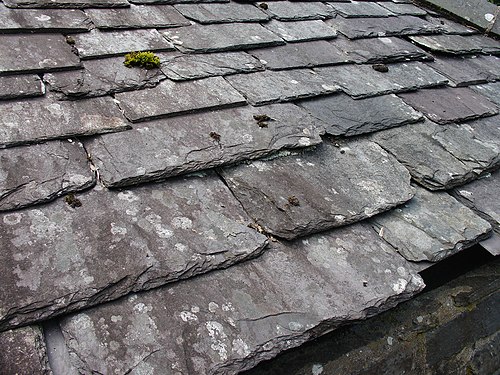
A slate roof in Cardiff, Wales

A slate-faced church and homes in Wurzbach, Germany