Smart meter
Videos
A smart meter is an electronic device that records information—such as consumption of electric energy, voltage levels, current, and power factor—and communicates the information to the consumer and electricity suppliers. Such an advanced metering infrastructure (AMI) differs from automatic meter reading (AMR) in that it enables two-way communication between the meter and the supplier.


Newer retrofitted U.S. domestic digital electricity meter Elster REX with 900MHz mesh network topology for automatic meter reading and "EnergyAxis" time-of-use metering.

Each local mesh networked smart meter has a hub such as this Elster A3 Type A30, which interfaces 900MHz smart meters to the metering automation server via a landline.

Itron OpenWay electricity Smart meter with two-way communications for remote reading in use by DTE Energy
Smart grid
Videos
The smart grid is an enhancement of the 20th century electrical grid, using two-way communications and distributed so-called intelligent devices. Two-way flows of electricity and information could improve the delivery network. Research is mainly focused on three systems of a smart grid – the infrastructure system, the management system, and the protection system. Electronic power conditioning and control of the production and distribution of electricity are important aspects of the smart grid.

Characteristics of a traditional system (left) versus the smart grid (right)
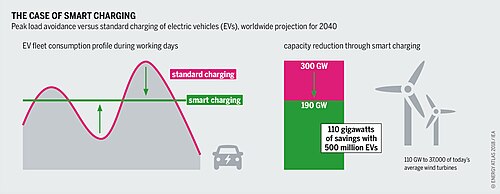
Peak load avoidance by smart charging of electric vehicles

End of line of T-pylons