Solar corona
Videos
The solar corona is the outermost layer of the Sun's atmosphere. It is a region filled with relatively hot, tenuous plasma that is structured by the solar magnetic field.

During a total solar eclipse, the Sun's corona and prominences are visible to the naked eye.

Temperatures in the solar atmosphere rise precipitously with height in the transition region between the chromosphere and corona.

The light visible close to the Sun during a total solar eclipse originates primarily from the K-corona.

The zodiacal light from sunlight scattered by interplanetary dust merges with the F-corona close to the Sun.
Solar eclipse
Videos
A solar eclipse occurs when the Moon passes between Earth and the Sun, thereby obscuring the view of the Sun from a small part of Earth, totally or partially. Such an alignment occurs approximately ev
Solar corona
…Coronal light is typically obscured by diffuse sky radiation and glare from the solar disk, but can be easily seen by the naked eye when the sun is completely or totally blocked in a solar eclipse, or with a specialized coronagraph. Spectroscopic measurements indicate strong ionization in the corona and a plasma temperature in…

An annular solar eclipse occurs when the Moon is too far away to completely cover the Sun's disk (October 14, 2023).
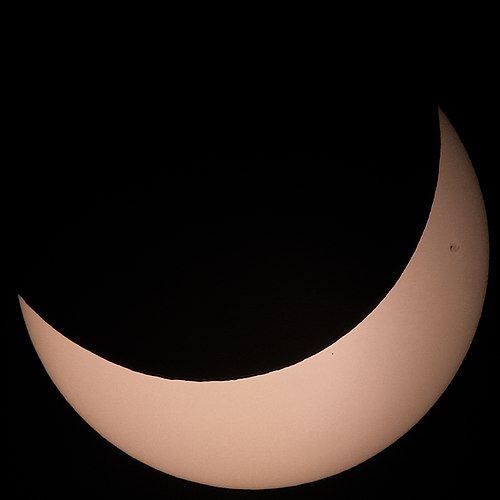
During a partial solar eclipse, the Moon blocks only part of the Sun's disk (October 25, 2022).
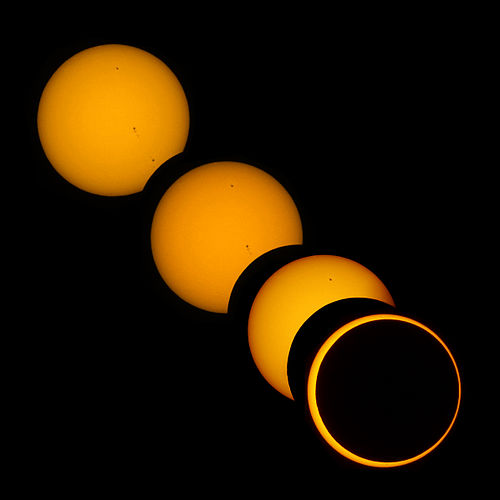
Partial and annular phases of the solar eclipse of May 20, 2012