A total solar eclipse, dubbed the "Great American Eclipse" by some media, occurred on Monday, August 21, 2017. It was visible within a band that spanned the contiguous United States from the Pacific t
The eclipse from outside Crowheart, Wyoming. This image used exposure bracketing to show both the Sun's corona and surface features of the Moon itself.


Solar eclipse and star system Regulus (upper left) viewed from Cullowhee, North Carolina

Viewing the eclipse at Oregon State University in Corvallis

Diamond ring effect and some prominences at the end of totality, Polk County Fairgrounds, Rickreall, Oregon
Solar eclipse
Videos
A solar eclipse occurs when the Moon passes between Earth and the Sun, thereby obscuring the view of the Sun from a small part of Earth, totally or partially. Such an alignment occurs approximately ev
Solar eclipse of August 21, 2017
…A total solar eclipse, dubbed the "Great American Eclipse" by some media, occurred on Monday, August 21, 2017. It was visible within a band that spanned the contiguous United…

A total solar eclipse occurs when the Moon completely covers the Sun's disk. Solar prominences can be seen along the limb (in red) as well as extensively the coronal and partly the radiating coronal streamers. (August 11, 1999)

An annular solar eclipse occurs when the Moon is too far away to completely cover the Sun's disk (October 14, 2023).
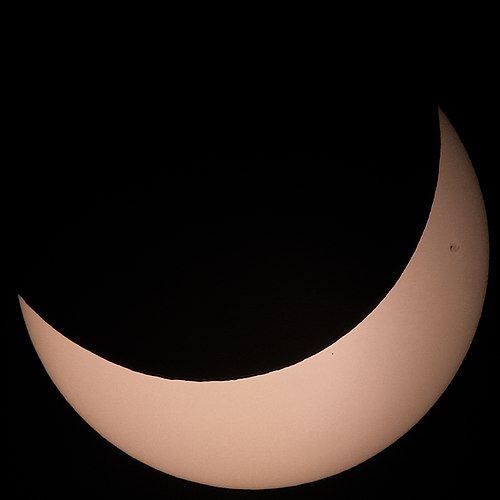
During a partial solar eclipse, the Moon blocks only part of the Sun's disk (October 25, 2022).
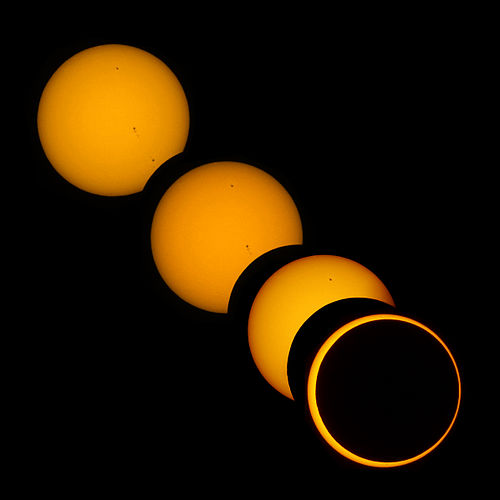
Partial and annular phases of the solar eclipse of May 20, 2012