Solar eclipse of January 14, 1926
Videos
Photos
A total solar eclipse occurred on January 14, 1926. A solar eclipse occurs when the Moon passes between Earth and the Sun, thereby totally or partly obscuring the Sun for a viewer on Earth. A total solar eclipse occurs when the Moon's apparent diameter is larger than the Sun's, blocking all direct sunlight, turning day into darkness. Totality occurs in a narrow path across Earth's surface, with the partial solar eclipse visible over a surrounding region thousands of kilometres wide. Totality was visible from French Equatorial Africa, northeastern Belgian Congo, southwestern tip of Anglo-Egyptian Sudan, British Uganda, British Kenya, southern tip of Italian Somaliland, British Seychelles, Dutch East Indies, North Borneo, and Philippines.

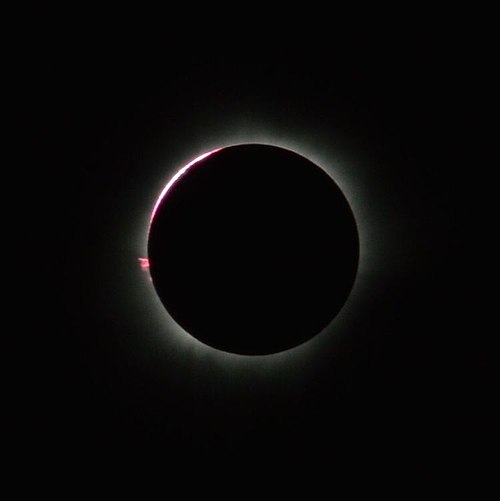
A photo of the eclipse, taken from Sumatra by John A. Miller of the Swarthmore expedition
Solar Saros 130
Videos
Photos
Saros cycle series 130 for solar eclipses occurs at the Moon's descending node, repeating every 18 years, 11 days, containing 73 eclipses, 43 of which are umbral. The first eclipse in the series was on 20 August 1096 and the last eclipse will be on 25 October 2394. The most recent eclipse was a total eclipse on 9 March 2016 and the next will be a total eclipse on 20 March 2034.
March 9, 2016 Series member 52