A total solar eclipse occurred on March 20, 2015. A solar eclipse occurs when the Moon passes between Earth and the Sun, thereby totally or partly obscuring the image of the Sun for a viewer on Earth. A total solar eclipse occurs when the Moon's apparent diameter is larger than the Sun's, blocking all direct sunlight, turning day into darkness. Totality occurs in a narrow path across Earth's surface, with a partial solar eclipse visible over a surrounding region thousands of kilometres wide. This total solar eclipse is notable in that the path of totality passed over the North Pole. Totality was visible in the Faroe Islands and Svalbard.

From Longyearbyen, Svalbard

Sheffield, United Kingdom. All time local time (GMT)

Lorient, France, 10:20 local time (9:20 GMT)

Berlin, Germany, 10:29 local time (9:29 UTC) – unconfirmed source
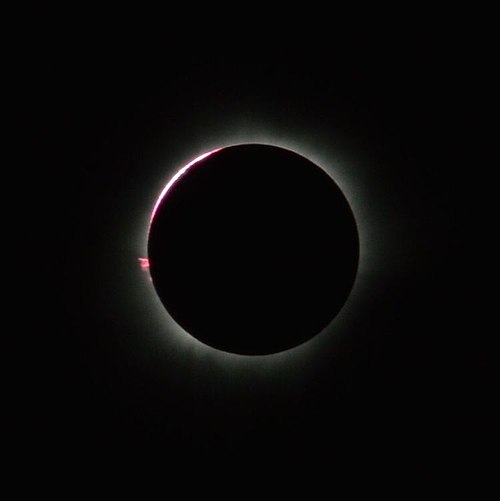
A total solar eclipse took place at the Moon's descending node of the orbit on March 8–9, 2016. If viewed from east of the International Date Line, the eclipse took place on March 8 (Tuesday) and elsewhere on March 9 (Wednesday). A total solar eclipse occurs when the Moon's apparent diameter is larger than the Sun's and the apparent path of the Sun and Moon intersect, blocking all direct sunlight and turning daylight into darkness; the Sun appears to be black with a halo around it. Totality occurs in a narrow path across Earth's surface, with the partial solar eclipse visible over a surrounding region thousands of kilometres wide. The eclipse of March 8–9, 2016 had a magnitude of 1.0450 visible across an area of Pacific Ocean, which started in the Indian Ocean, and ended in the northern Pacific Ocean.
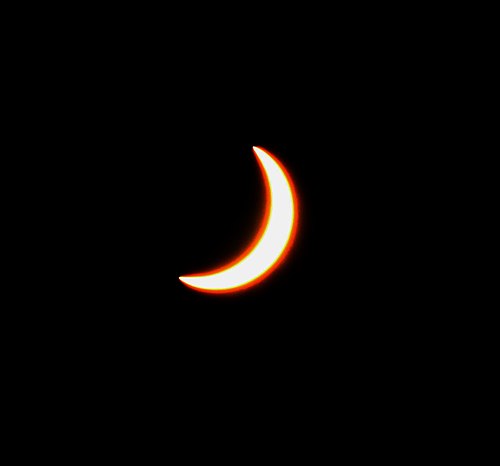
Partial in Jakarta, Indonesia, 0:23 UTC

Partial in Nanyang Technological University, Singapore, 0:23 UTC
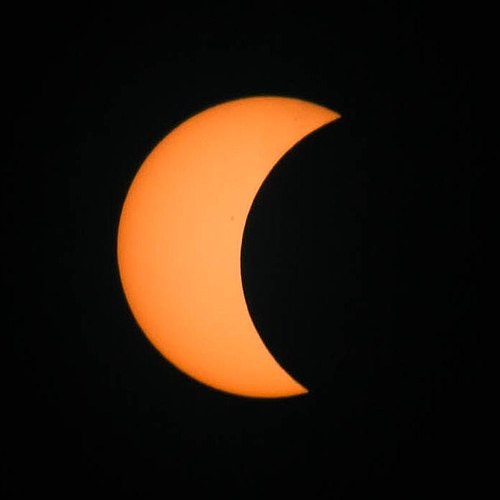
Partial in Ho Chi Minh City, Vietnam, 0:26 UTC