Solidus
Videos
The solidus or nomisma was a highly pure gold coin issued in the Later Roman Empire and Byzantine Empire. It was introduced in the early 4th century, replacing the aureus, and its weight of about 4.45


Solidus of Theodosius II, minted in Constantinople c. 435. This design of the emperor with the spear over his shoulder was the conventional portrait for over a century in the Eastern Roman Empire, from AD 395 to 537

Solidus of Constantine the Great, minted in AD 324 or 325

Solidus of Constantius II from Antioch, 347–355. A holed coin such as this was likely worn as a jewelry piece by a prominent or wealthy Roman

Light-weight solidus of 22 siliquae minted by emperor Tiberius Constantine at Antioch in Syria, c. 580. The light-weight solidi were minted from c. 550–650 and were primarily used for foreign trade with Europe.
Byzantine Empire
Videos
The Byzantine Empire, also known as the Eastern Roman Empire, was the continuation of the Roman Empire centred on Constantinople during late antiquity and the Middle Ages. Having survived the fall of
Solidus
…solid'; pl.: solidi) or nomisma (Greek: νόμισμα, romanized: nómisma, lit. 'coin') was a highly pure gold coin issued in the Later Roman Empire and Byzantine Empire. It was introduced in the early 4th century, replacing the aureus, and its weight of about 4.45 grams remained relatively constant for seven centuries…

Constantine I, also known as Constantine the Great, was Roman emperor from AD 306 to 337 and the first Roman emperor to convert to Christianity. He founded the city of Constantinople (now Istanbul) and made it the capital of the Empire, which it remained for over a millennium.

The Theodosian Walls of Constantinople, very important during the 717–718 siege
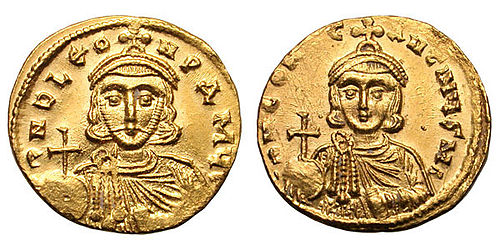
Gold solidus of Leo III (left) and his son and heir, Constantine V (right)

The seizure of Edessa (1031) by the Byzantines under George Maniakes and the counterattack by the Seljuk Turks