Soluta is an extinct class of echinoderms that lived from the Middle Cambrian to the Early Devonian. The class is also known by its junior synonym Homoiostelea. Soluta is one of the four "carpoid" classes, alongside Ctenocystoidea, Cincta, and Stylophora, which made up the obsolete subphylum Homalozoa. Solutes were asymmetric animals with a stereom skeleton and two appendages, an arm extending anteriorly and a posterior appendage called a homoiostele.
Soluta (echinoderm)
An echinoderm is any deuterostomal animal of the phylum Echinodermata, which includes starfish, brittle stars, sea urchins, sand dollars and sea cucumbers, as well as the sessile sea lilies or "stone lilies". While bilaterally symmetrical as larvae, as adults echinoderms are recognisable by their usually five-pointed radial symmetry, and are found on the sea bed at every ocean depth from the intertidal zone to the abyssal zone. The phylum contains about 7,600 living species, making it the second-largest group of deuterostomes after the chordates, as well as the largest marine-only phylum. The first definitive echinoderms appeared near the start of the Cambrian.
Echinoderm
A brittle star, Ophionereis reticulata
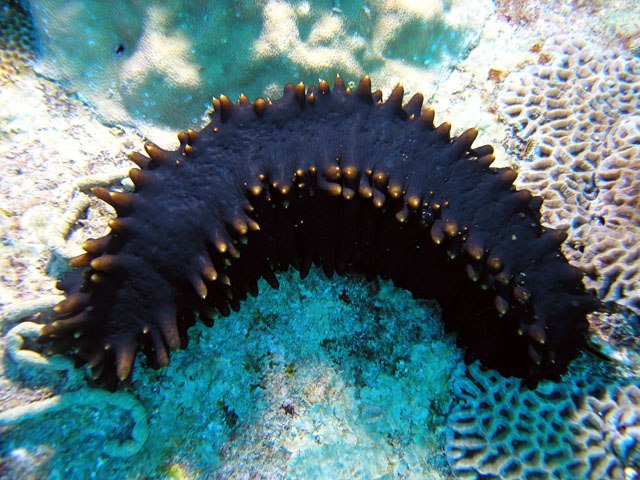
A sea cucumber, Stichopus chloronotus, from Malaysia
Starfish of varied colours