The South Aral Sea was a lake in the basin of the former Aral Sea which formed in 1987 when that body divided in two, due to diversion of river inflow for agriculture. In 2003, the South Aral Sea itself split into eastern and western basins, the Eastern Sea and the West Aral Sea, connected by a narrow channel that balanced surface levels but did not allow mixing, and in 2005 the North Aral Sea was dammed to prevent the collapse of its fisheries, cutting off the only remaining inflow to the southern lakes. In 2008, the Eastern Sea split again, and in May 2009 had almost completely dried out, leaving only the small permanent Barsakelmes Lake between the Northern and Western Seas and increasing the expanse of the Aralkum desert. In 2010, it was partially filled again by meltwater, and by 2014 was once again dry. The West Aral Sea has some replenishment from groundwater in the northwest.
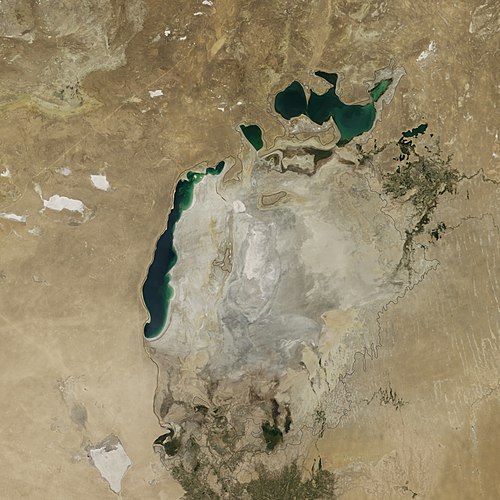
The Aral Sea in mid-August 2014. The two remaining lakes to the south and west are the remains of the South Aral Sea.
July 2002 – The sea's former bed is visible as lighter-colored areas, the lightest regions representing the most recent retreat.
November 2003 – Much of the Eastern Sea's water has evaporated, the jade green swirls representing sediment in the shallow water.
August 2009 – The Eastern Sea's mud flats have dried further, with only the faintest glimmer of water where it drains into the Western Sea. Barsakelmes Lake appears between the Northern and Western seas.
The Aral Sea is an endorheic lake lying between Kazakhstan to its north and Uzbekistan to its south which began shrinking in the 1960s and largely dried up by the 2010s. It was in the Aktobe and Kyzylorda regions of Kazakhstan and the Karakalpakstan autonomous region of Uzbekistan. The name roughly translates from Mongolic and Turkic languages to "Sea of Islands", a reference to the large number of islands that once dotted its waters. The Aral Sea drainage basin encompasses Uzbekistan and parts of Afghanistan, Iran, Kazakhstan, Kyrgyzstan, Tajikistan, and Turkmenistan.
The Aral Sea in 1989 (left) and 2014 (right)
The Syr Darya sturgeon (Pseudoscaphirhynchus fedtschenkoi) was a primitive species of fish possibly driven to extinction by the shrinkage of the Aral Sea.
The Ukrainian stickleback (Pungitius platygaster) was the only native species of the Aral Sea to survive its reduction and salinization.
The European flounder (Platichthys flesus) was a saltwater fish introduced to the Aral Sea.