Space Shuttle Challenger
Videos
Space Shuttle Challenger was a Space Shuttle orbiter manufactured by Rockwell International and operated by NASA. Named after the commanding ship of a nineteenth-century scientific expedition that tra

Challenger in orbit in 1983, during STS-7

Challenger being prepared in 1985 for its penultimate flight, STS-61-A

Challenger atop a Crawler-transporter, en route to the launch site for its final flight, STS-51-L

Challenger being transported by Shuttle Carrier Aircraft 905, shortly before being delivered in 1982
On January 28, 1986, Space Shuttle Challenger broke apart 73 seconds into its flight, killing all seven crew members. The spacecraft disintegrated about 46,000 feet above the Atlantic Ocean, off the c
Space Shuttle Challenger
…Shuttle orbiter to fly into space after Columbia, and launched on its maiden flight in April 1983. It was destroyed in January 1986 soon after launch in a disaster that killed all seven crewmembers aboard. Initially manufactured as a test article not intended for spaceflight, it was used for ground testing of the…
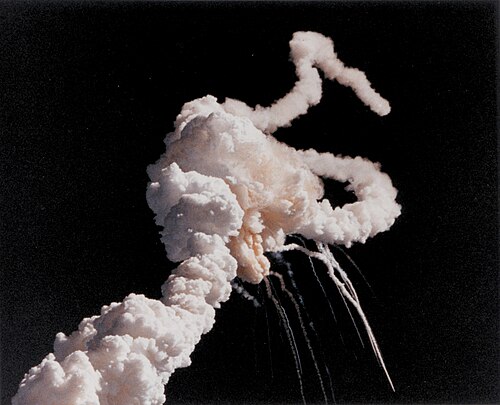
Challenger's solid rocket boosters fly uncontrollably after the breakup of the external tank separated them from the shuttle stack. The remains of the orbiter and tank leave thin white trails as they fall toward the Atlantic Ocean.

Cross-sectional diagram of the original SRB field joint. The top end of the lower rocket segment has a deep U-shaped cavity, or clevis, along its circumference. The bottom end of the top segment extends to form a tang that fits snugly into the clevis of the bottom segment. Two parallel grooves near the top of the clevis inner branch hold ~20 foot (6 meter) diameter O-rings that seal the gap between the tang and the clevis, keeping hot gases out of the gap.

STS-51-L crew: (back) Onizuka, McAuliffe, Jarvis, Resnik; (front) Smith, Scobee, McNair.