The Space Shuttle Solid Rocket Booster was the first solid-propellant rocket to be used for primary propulsion on a vehicle used for human spaceflight. The two SRBs provided 85% of the Space Shuttle's
Two Space Shuttle SRBs on the crawler-transporter in preparation for the launch of STS-134


One of the two SLS Block I SRBs for Artemis I

Static test firing, 1978.

Sections of the SRB filled with propellant being connected for the STS-134 mission
On January 28, 1986, Space Shuttle Challenger broke apart 73 seconds into its flight, killing all seven crew members. The spacecraft disintegrated about 46,000 feet above the Atlantic Ocean, off the c
Space Shuttle Solid Rocket Booster
…program, all but four were recovered – those from STS-4 (due to a parachute malfunction) and STS-51-L (destroyed by the range safety officer during the Challenger disaster). Over 5,000 parts were refurbished for reuse after each flight. The final set of SRBs that launched STS-135 included parts that had flown on 59 previous…
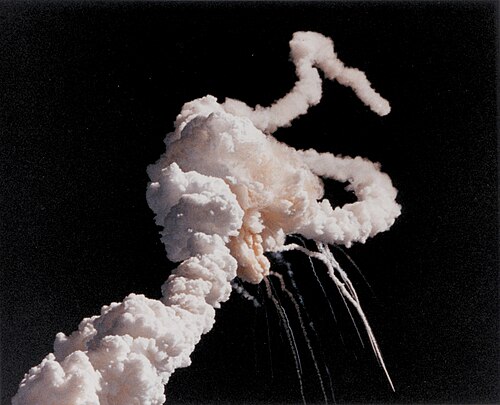
Challenger's solid rocket boosters fly uncontrollably after the breakup of the external tank separated them from the shuttle stack. The remains of the orbiter and tank leave thin white trails as they fall toward the Atlantic Ocean.

Space Shuttle Challenger – assembled for launch along with the ET and two SRBs – atop a crawler-transporter en route to the launch pad about one month before the disaster

Cross-sectional diagram of the original SRB field joint. The top end of the lower rocket segment has a deep U-shaped cavity, or clevis, along its circumference. The bottom end of the top segment extends to form a tang that fits snugly into the clevis of the bottom segment. Two parallel grooves near the top of the clevis inner branch hold ~20 foot (6 meter) diameter O-rings that seal the gap between the tang and the clevis, keeping hot gases out of the gap.

STS-51-L crew: (back) Onizuka, McAuliffe, Jarvis, Resnik; (front) Smith, Scobee, McNair.