Space debris
Videos
Space debris are defunct human-made objects in space – principally in Earth orbit – which no longer serve a useful function. These include derelict spacecraft, mission-related debris, and particularly-numerous in-Earth orbit, fragmentation debris from the breakup of derelict rocket bodies and spacecraft. In addition to derelict human-made objects left in orbit, space debris includes fragments from disintegration, erosion, or collisions; solidified liquids expelled from spacecraft; unburned particles from solid rocket motors; and even paint flecks. Space debris represents a risk to spacecraft.


Vanguard 1 is expected to remain in orbit for 240 years.

A drifting thermal blanket photographed in 1998 during STS-88

Spent upper stage of a Delta II rocket, photographed by the XSS 10 satellite
Anti-satellite weapon
Videos
Anti-satellite weapons (ASAT) are space weapons designed to incapacitate or destroy satellites for strategic or tactical purposes. Although no ASAT system has yet been utilized in warfare, a few countries have successfully shot down their own satellites to demonstrate their ASAT capabilities in a show of force. ASATs have also been used to remove decommissioned satellites.

An artist's impression of a futuristic anti-satellite weapon capable of destroying satellites using its "circular saw" extensions

A US ASM-135 ASAT missile
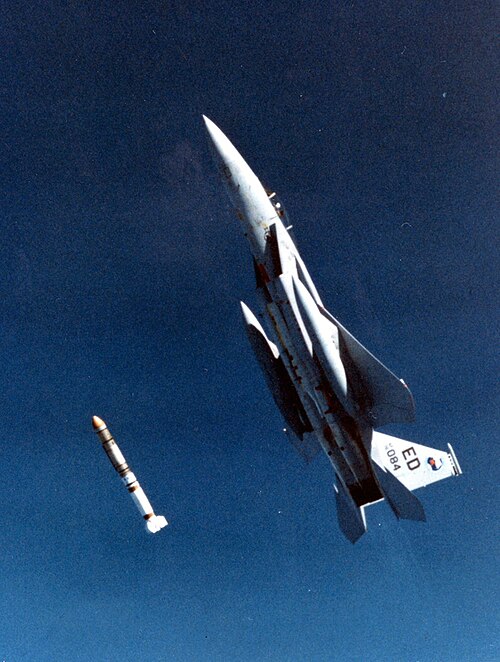
A US Vought ASM-135 ASAT missile launch on 13 September 1985, which destroyed P78-1

A RIM-161 Standard Missile 3 launched from USS Lake Erie, a US Navy Ticonderoga class cruiser, 2005