Spanish confiscation
Videos
The Spanish confiscation was the Spanish government's seizure and sale of property, including from the Catholic Church, from the late 18th century to the early 20th century. It was a long historical,

The sepulchre of Ermengol X (1274–1314), Count of Urgell and Viscount of Àger, was sold in the 19th century during the Ecclesiastical Confiscations of Mendizábal. It is now displayed in the Cloisters in New York City.

The Renaissance courtyard of the Castle of Vélez-Blanco (c. 16th century), which was sold to the United States during the liberal confiscation in 1903 and is now in the Metropolitan Museum of Art in New York.

A portrait of Pablo de Olavide by Juan Moreno Tejada, painted before 1805.

Gaspar Melchor de Jovellanos, portrayed by Goya.
Cortes of Cádiz
Videos
The Cortes of Cádiz was a revival of the traditional cortes, which as an institution had not functioned for many years, but it met as a single body, rather than divided into estates as with previous o
Monument in Cádiz to the Cortes and the 1812 constitution


Oath of the Cortes of Cádiz in the main parish church of San Fernando, the work of José Casado del Alisal. Presented at the Congress of Deputies in Madrid

Real Teatro de las Cortes, where the deputies who drafted the Spanish Constitution of 1812 met between 24 September 1810, and 20 February 1811.
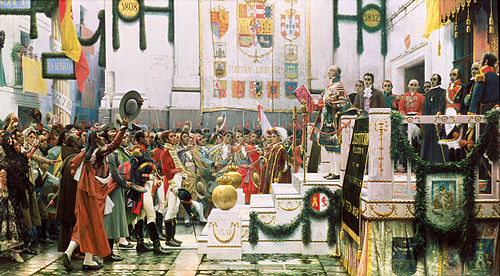
The declaration of the Constitution of 1812, the work of Salvador Viniegra (Museo de las Cortes de Cádiz)