Spektr-R
Videos
Spektr-R was a Russian scientific satellite with a 10 m radio telescope on board. It was launched on 18 July 2011 on a Zenit-3F launcher from Baikonur Cosmodrome, and was designed to perform research

Spektr-R at the integration and test complex of Launch Pad No.31, the Baikonur Space Center in July 2011

Model of Spektr-R

A selection of telescopes operating at wavelengths across the electromagnetic spectrum
Very-long-baseline interferometry is a type of astronomical interferometry used in radio astronomy. In VLBI a signal from an astronomical radio source, such as a quasar, is collected at multiple radio
Spektr-R
…near-Earth and interplanetary plasma. The very high angular resolving power was achieved in conjunction with a ground-based system of radio-telescopes and interferometrical methods, operating at wavelengths of 1.35–6.0, 18.0 and 92.0 cm. Once in space, the flower-like main dish was to open its 27 'petals' within 30 minutes. There…

Some of the Atacama Large Millimeter Array radio telescopes

The eight radio telescopes of the Smithsonian Submillimeter Array, located at the Mauna Kea Observatory in Hawai'i
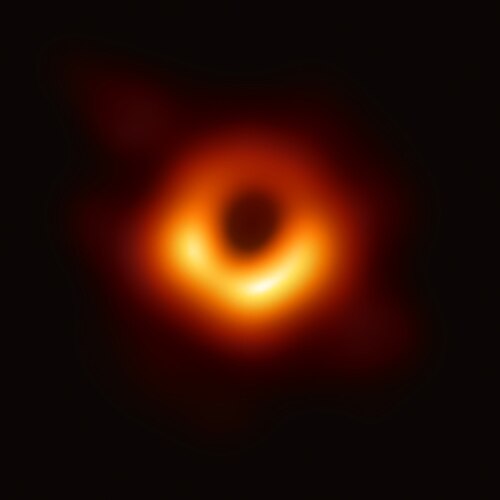
VLBI was used to create the first image of a black hole, imaged by the Event Horizon Telescope and published in April 2019.

Image of the source IRC +10420. The lower resolution image on the left was taken with the UK's MERLIN array and shows the shell of maser emission produced by an expanding shell of gas with a diameter about 200 times that of the Solar System. The shell of gas was ejected from a supergiant star (10 times the mass of the Sun) at the centre of the emission about 900 years ago. The corresponding EVN e-VLBI image (right) shows the much finer structure of the masers made visible with the higher resolution of the VLBI array.